
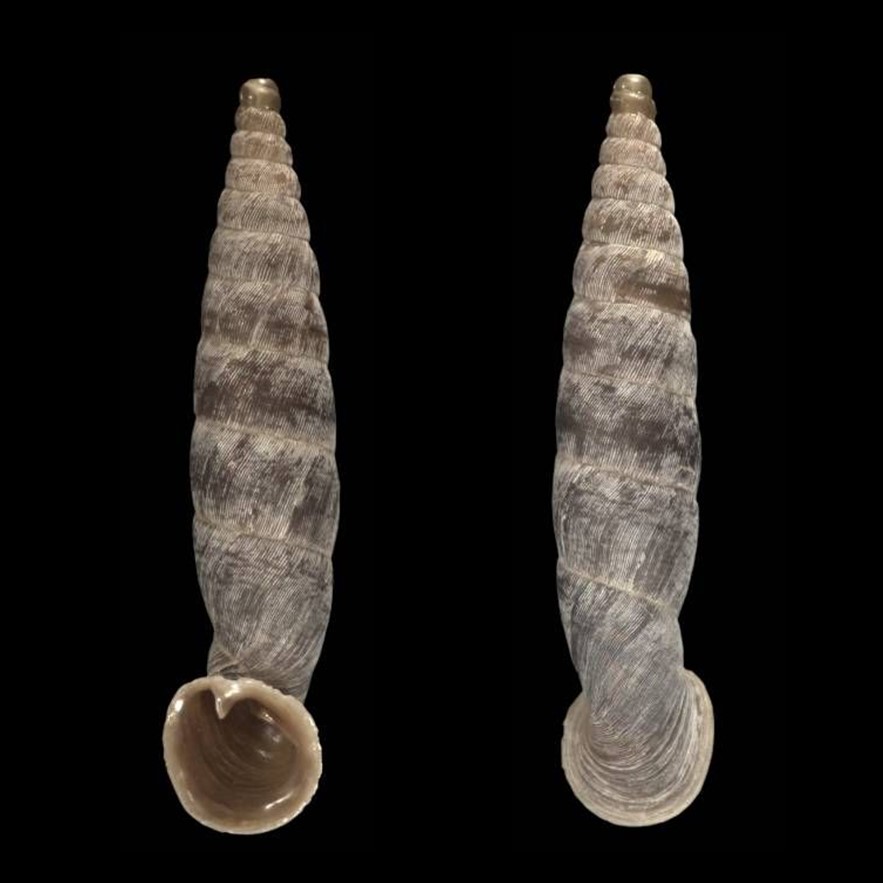
CLASSE: GASTROPODA: TERRESTRE
FAMÍLIA: CLAUSILIIDAE
ESPÉCIE: Andiniastra violascens H. Nordsieck, 2005
Tamanho médio: 21.7 – 27.7 mm
Ocorrência: Peru (Amazonas)
Localidade tipo: Peru, Departamento de Amazonas, “ca. 35 km from Chachapoyas to Pedro Ruiz”
Nome original: Andiniastra violascens H. Nordsieck, 2005
Etimologia: o nome da espécie é uma referência à coloração da concha, do Latim “violascens” = violet-coloured
Descrição original:
(Nordsieck, 2005): “Shell slightly decollated (only uppermost whorls missing), occasionally entire, with conical apical part, whorls less rounded; violet reddish-brown, with white ribs; teleoconch whorls regularly densely ribbed, riblets ± lengthwise white, in part incompletely, especially on the lower whorls and parts rubbed off, in part below the suture patches of white riblets alternating with non-white ones;
riblets on the neck ± coarser and somewhat undulating; neck nearly rounded, ± with subsutural swelling, umbilicus open; aperture protruding, roundish-oval to rhombic-oval, reddish-brown inside, with expanded peristome; superior lamella high, continuous
with spiral lamella by a ± marked curve, faintly or not elongated by its side, lamellae at the connection much lowered, spiral lamella lower; inferior lamella ascending with a weak spiral, high or moderately high inwards, in front lowered and ± bent on the columellar edge, slightly or hardly not thickened and ending; subcolumellar lamella descending to the lunellar, lower end separated from lunella, in oblique view visible far inwards;
lunellar dorsal-dorsolateral in position, in part dorsal, principal plica ending dorsolaterally, in part more dorsally or more laterally; upper palatal plica continuous with lunella by a curve or an angle, lunella straight or somewhat arcuate, lower palatal plicae missing, rarely lower end of lunella spur-like widened = rudiment of anterior lower palatal plica; clausilium plate in oblique
view fully visible, in part leaving gaps at the palatal and the columellar side, distally ± pointed and bent outward.”
Fotos: (1) Forschungsinstitut und Naturmuseum Senckenberg: HOLOTYPE de Andiniastra violascens, SMF 328068, Peru, “Dept. Amazonas, ca. 35 km from Chachapoyas to Pedro Ruiz, 06°03.706′ S 77°55.042′ W”, 28.iii.2004, leg. Hemmen, 27.6mm
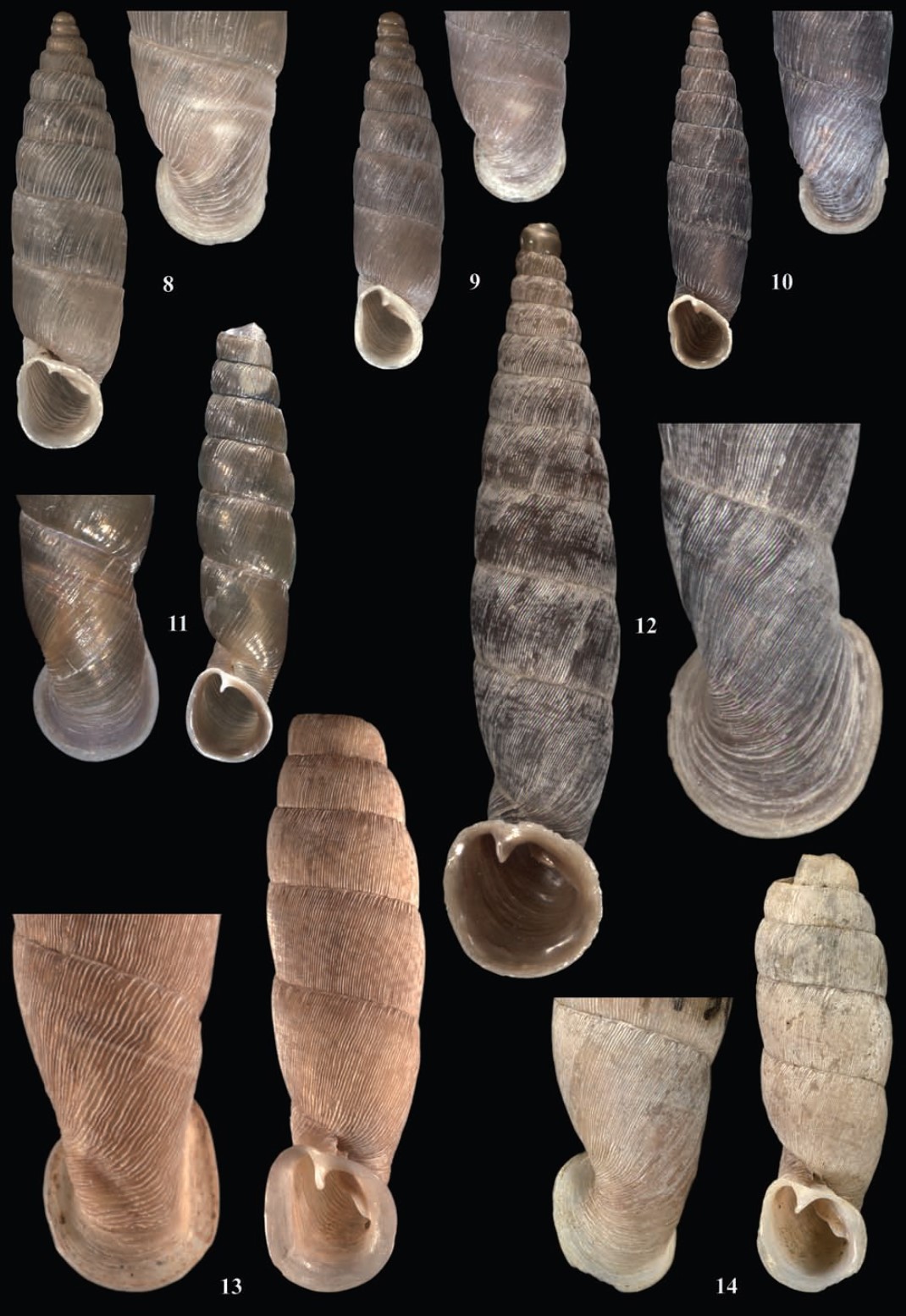
Figura: Nordsieck, 2005:
(8) Parabalea latestriata latestriata WEYRAUCH, HOLOTYPE, SMF 156232, Peru, Dept. Junin, above Acolla, on road Tarma-Jauja (3700 m), 28.ii.1957, leg. Weyrauch, 16.0 mm;
(9) Parabalea latestriata densestriata, HOLOTYPE, SMF 328099, Peru, Dept. Junin, ca. km 35.5 road La Oroya-Junin (ca. 3800 m), 19.x.2004, leg. Hemmen, 13.1 mm;
(10) Parabalea gibbosula, HOLOTYPE, SMF 328033, Peru, Dept. Junin, ca. 22 km from Tarma to La Oroya (ca. 4000 m), 15.x.2004, leg. Hemmen, 13.1 mm;
(11) Gracilinenia nitens, HOLOTYPE, SMF 328025, Peru, Dept. Huanuco, waterfalls of Tambillo (ca. 13 km S Tingo Maria), 15.iv.2005, leg. Hemmen, 16.1 mm;
(12) Andiniastra violascens, HOLOTYPE, SMF 328068, Peru, Dept. Amazonas, ca. 35 km from Chachapoyas to Pedro Ruiz, 28.iii.2004, leg. Hemmen, 27.6 mm;
(13) Cylindronenia pangamitoensis pongoensis, HOLOTYPE, SMF 322804, Peru, Dept. Amazonas, Pongo de Rentema-Bagua Chica, xii.1998, leg. Richards, 21.3 mm;
(14) Cylindronenia pangamitoensis pangamitoensis (Loosjes & Loosjesvan Bemmel), PARATYPE, NNM 56308a, Peru, Dept. Amazonas, Pangamito (S Bagua, E Bagua Grande) (1000 m), 22.X.1980, leg. Hoocking, 16.1 mm
Fontes:
Descrição original: Nordsieck, H. (2005). Revision of the system of the Peruvian Neniinae (Gastropoda: Stylommatophora: Clausiliidae), with description of new taxa. Archiv für Molluskenkunde. 134 (2): 197-221, 3 pls. Frankfurt am Main.
página(s): 210, fig. 12
Senckenberg. Collection Mollusca SMF. Occurrence dataset https://doi.org/10.15468/ohuexz accessed via GBIF.org on 2025-12-11. https://www.gbif.org/occurrence/207680334
Molluscabase: https://molluscabase.org/aphia.php?p=taxdetails&id=1291571

Vive em árvores e arbustos

Vive sob ou sobre pedras

Vive em corais ou recifes

Vive em algas marinhas

Vivem em fundos de cascalho de coral, pedra ou conchas

Vive no solo. Sob folhas ou enterada parte do tempo

Vive em fundos arenosos, enterrada ou sob ele.

Animais que nadam ou vivem livremente

Presos a certos animais ou parasitando

Vive em fundos lodosos

Vive em plantas de água doce

Seu habitat é desconhecido

Alimenta-se de plantas e algas

Alimenta-se de outros animais

Alimenta-se de qualquer fonte

Alimenta-se de animais mortos
Seu hábito alimentar é desconhecido


