

CLASSE: GASTROPODA: TERRESTRE
FAMÍLIA: CLAUSILIIDAE
ESPÉCIE: Columbinia ehrmanni H. Nordsieck, 2005
Tamanho médio: 24 mm
Ocorrência: Peru (Huánuco)
Localidade tipo: Peru, “Callanga, coll. EHRMANN, ex SCHLÜTER”
Comentários: Callanga está cerca de 300 km ao Sul de Tingo Maria
Nome original: Columbinia (Steatonenia) ehrmanni H. Nordsieck, 2005
Etimologia: o nome da espécie é uma homenagem ao malacologista alemão Paul Hermann Felix Ehrmann (1868-1937)
Descrição original:
(Nordsieck, 2005): “Shell with broad conical apical part, whorls less rounded; yellowish reddish-brown, with light subsutural band, especially on the upper whorls; first teleoconch whorl obliquely ribbed, the following ones with undulating ribs, on the neck ribs more narrowly spaced and less undulating; neck nearly rounded, with subsutural swelling; aperture protruding, oval to rhombicoval, yellowish reddish-brown inside; superior lamella high, continuous with spiral lamella by a marked curve, in part elongated by its side, lamellae at the connection hardly lowered, spiral lamella of different height; inferior lamella ascending with a weak spiral, moderately high inwards, in front lowered and bent on the columellar edge, continued to the peristome;
subcolumellar lamella descending to the lunellar, lower end separated from lunella, in oblique view visible ± far inwards; lunellar dorsal-dorsolateral in position, principal plica ending dorsolaterally; upper palatal plica continuous with lunella by a curve or an indistinct angle, lunella with straight lower part, lower end widened = rudiment of posterior lower palatal plica; clausilium plate in oblique view fully visible, relatively broad, in part leaving a gap at the palatal side, distally somewhat pointed at the outer end.”
Fotos: (1) Nordsieck, 2005: HOLOTYPE de Columbinia ehrmanni, HOLOTYPE, SMF 328193, Peru, Callanga, ex Schlüter, 24.1 mm
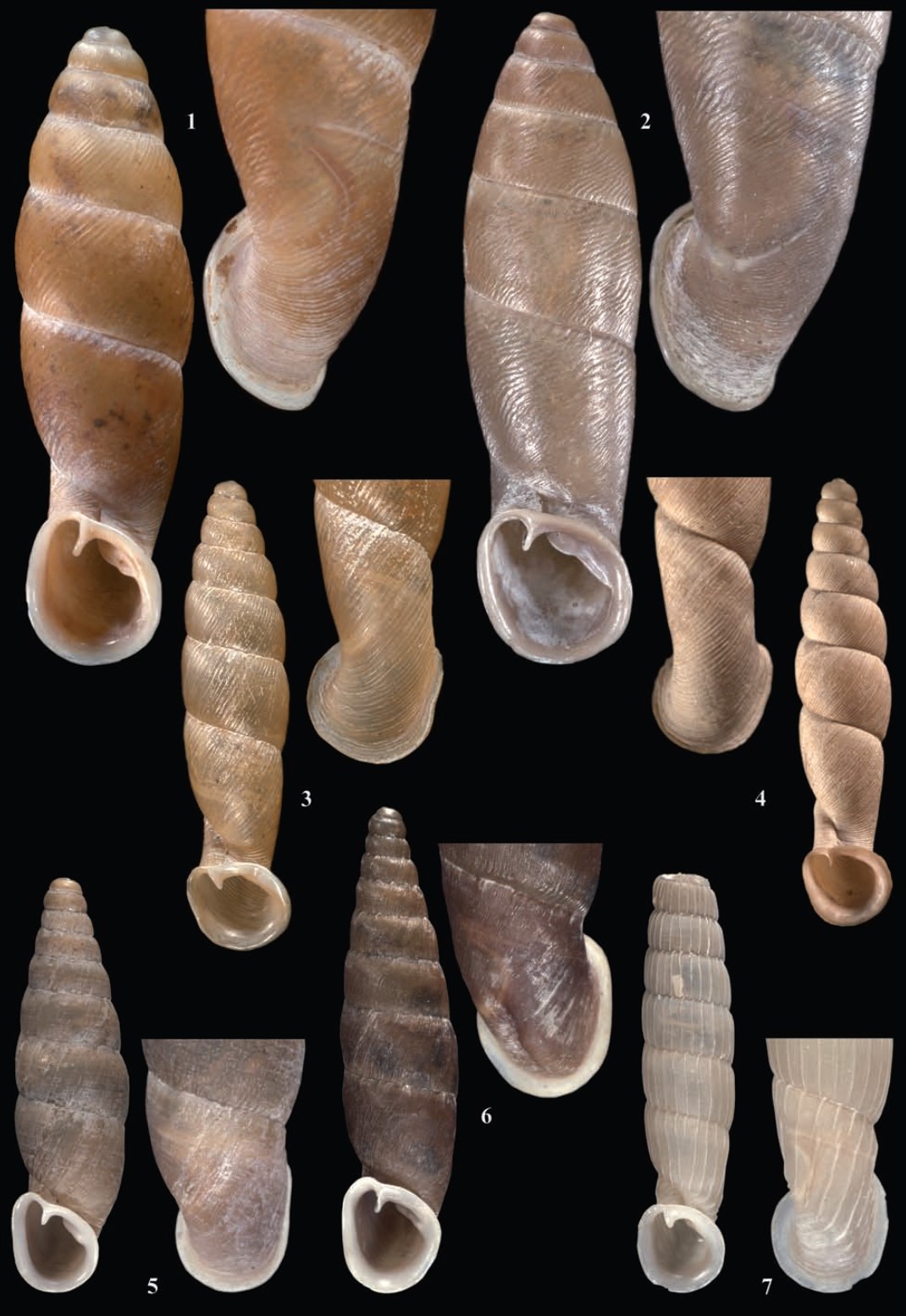
Figura: Nordsieck, 2005:
(1) Columbinia bartletti H. Adams, LECTOTYPE, NHMUK 1867.5.18.1, Peru [on the river Ucayali], leg. BARTLETT, H = 23.35 mm;
(2) Columbinia ehrmanni, HOLOTYPE, SMF 328193, Peru, Callanga, ex SCHLÜTER, H = 24.1 mm;
(3) Columbinia adamsiana L. Pfeiffer, LECTOTYPE, NHMUK 1958.9.3.5, Peru [ad fluvium Chanchamaya], ex THAMM, H = 17.2 mm
(4) Columbinia convexivolvis, HOLOTYPE, MNHN, Peru, banks of Rio Oxabamba, 1879, leg. BER, H = 16.4 mm;
(5) Cyclonenia hemmeni, HOLOTYPE SMF 327767, Peru, Dept. Cajamarca, ca. km 148.2 road Pacasmayo-Cajamarca (ca. 2500 m), 27.x.2004, leg. HEMMEN, H = 15.2 mm;
(6) Cyclonenia gibber sagasteguii, subsp., HOLOTYPE, SMF 172140, Peru, Dept. La Libertad, Prov. Bolivar, Laguna de los Ichus (3200 m), 29.v.1960, leg. SAGASTEGUI, H = 17.8 mm;
(7) Neniella strictecostata, HOLOTYPE, SMF 327789, Peru, Dept. Amazonas, ca. 20 km from bridge (over Rio Marañon) near Balsas to Leymebamba, 2.xi.2004, leg. HEMMEN, H = 15.4 mm
Fontes:
Descrição original: (como Columbinia (Steatonenia) ehrmanni H. Nordsieck, 2005) Nordsieck, H. (2005). Revision of the system of the Peruvian Neniinae (Gastropoda: Stylommatophora: Clausiliidae), with description of new taxa. Archiv für Molluskenkunde. 134 (2): 197-221, 3 pls. Frankfurt am Main.
página(s): 206, fig. 2
Nordsieck, H. (2007). Worldwide Door Snails (Clausiliidae), Recent and Fossil. ConchBooks, Hackenheim, 214 pp.
página(s): 39
Molluscabase: https://molluscabase.org/aphia.php?p=taxdetails&id=1291578

Vive em árvores e arbustos

Vive sob ou sobre pedras

Vive em corais ou recifes

Vive em algas marinhas

Vivem em fundos de cascalho de coral, pedra ou conchas

Vive no solo. Sob folhas ou enterada parte do tempo

Vive em fundos arenosos, enterrada ou sob ele.

Animais que nadam ou vivem livremente

Presos a certos animais ou parasitando

Vive em fundos lodosos

Vive em plantas de água doce

Seu habitat é desconhecido

Alimenta-se de plantas e algas

Alimenta-se de outros animais

Alimenta-se de qualquer fonte

Alimenta-se de animais mortos
Seu hábito alimentar é desconhecido


