
CLASSE: GASTROPODA: TERRESTRE
FAMÍLIA: BULIMULIDAE
ESPÉCIE: Drymaeus valentini Breure & Vega-Luz, 2020
Tamanho médio: 27 mm
Habitat: Vive em árvores e arbustos nas Yungas Peruanas
Ocorrência: Peru, Departamento de Amazonas
Localidade tipo: Peru, Departamento Amazonas, próximo a Molinopampa
Altitude: ~ 2600 m
Nome original: Drymaeus (Drymaeus) valentini Breure & Vega-Luz, 2020
Sinônimos: Antidrymaeus valentini (Breure & Vega-Luz, 2020)
Etimologia: o nome da espécie é uma homenagem ao malacólogo e pesquisador Peruano Valentin Mogollónn Ávila (Lima)
Zoobank: http://zoobank.org/NomenclaturalActs/ba319ee1-0d20-449e-95a1-a93daa7230ca
Descrição original:
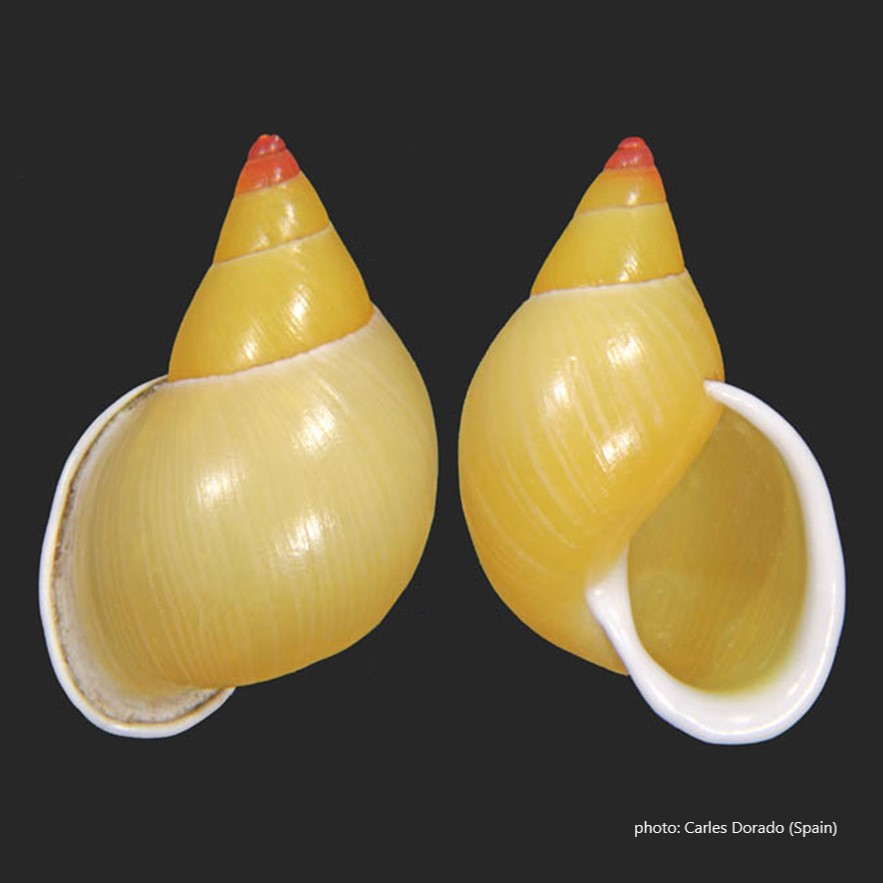
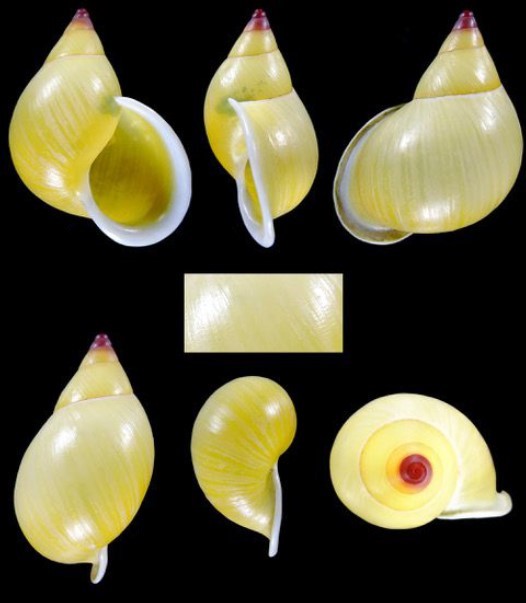
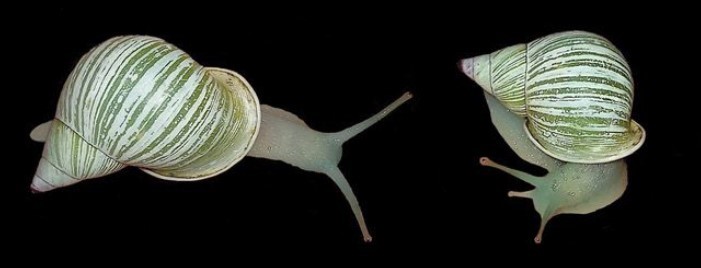
(Breure & Vega-Luz, 2020): “Shell up to 27.1 mm height, 1.5 times as long as wide, imperforate, the spire with almost straight sides, rather thin. Colour moss- to dark-green (when alive) to yellowish to transparent with a light yellow-green tone (when dead), with whitish lines irregularly spaced and of variable width axially arranged in a skewed pattern, several connected to each other, with tiny spots or blotches of white between them. Upper whorls pink to purplish. Surface dull; the upper whorls smooth, the last whorl with some indistinct, interrupted spiral grooves. Protoconch with a reticulate sculpture of riblets and spiral striae, which are of equal strength and form a grating pattern. Whorls 5.4, nearly flat except the last whorl which is swollen and saccate, last whorl 0.8 times the total shell height; suture slightly impressed, hardly ascending behind the lip. Aperture ovate, somewhat skewed to the lateral side, 1.6 times longer than wide, 0.59 times the total height. Peristome expanded and reflected, white. Columellar margin curved, reflected, white. Parietal wall with a very thin, transparent callus.”
Fotos: (1) cortesia Carles Dorado (Espanha); (2) Breure & Vega-Luz, 2020: Museo Nacional de Ciencias Naturales, Madrid: HOLOTYPE MNCN 15.05/200118H, Peru, “Dept. Amazonas, near Molinopampa”, -6.208 S, -77.667 W, ca. 2600 m, doador Valentin Castillo Villaneuva, 24.xi.2020; (3) Breure & Vega-Luz, 2020: animais vivos
Fontes:
Descrição original: (como Drymaeus (Drymaeus) valentini Breure & Vega-Luz, 2020) Breure, A. S. H. & Vega-Luz, R. (2020). Mystery solved: a new Drymaeus species from northern Peru (Mollusca, Gastropoda, Bulimulidae). Folia Conchyliologica. 59: 1-4.
página(s): 2, figs 2-4
Dorado, C. & Roosen, M. (2023). Descripción de una nueva especie del género Drymaeus (Albers, 1850) para el norte de Perú y nuevos datos sobre Drymaeus valentini (Gastropoda: Bulimulidae). Nemus. 13: 113-119.
página(s): 116
Breure, Abraham S.H.; Oroño, Eugenia Salas; Ablett, Jonathan D.; Vega-Luz, Ricardo & Mogollón Ávila, Valentín (2024): Struggling with shells: Drymaeus Albers, 1850 and Mesembrinus Albers, 1850 species (Mollusca, Gastropoda, Bulimulidae) from Peru—an illustrated checklist and descriptions of new species. Journal of Conchology 45 (2), 2024. disponível online em https://conchsoc.org/jconch-45-2
MolluscaBase: https://www.molluscabase.org/aphia.php?p=taxdetails&id=1472194

Vive em árvores e arbustos

Vive sob ou sobre pedras

Vive em corais ou recifes

Vive em algas marinhas

Vivem em fundos de cascalho de coral, pedra ou conchas

Vive no solo. Sob folhas ou enterada parte do tempo

Vive em fundos arenosos, enterrada ou sob ele.

Animais que nadam ou vivem livremente

Presos a certos animais ou parasitando

Vive em fundos lodosos

Vive em plantas de água doce

Seu habitat é desconhecido

Alimenta-se de plantas e algas

Alimenta-se de outros animais

Alimenta-se de qualquer fonte

Alimenta-se de animais mortos
Seu hábito alimentar é desconhecido


