
CLASSE: GASTROPODA: TERRESTRE
FAMÍLIA: HELICINIDAE
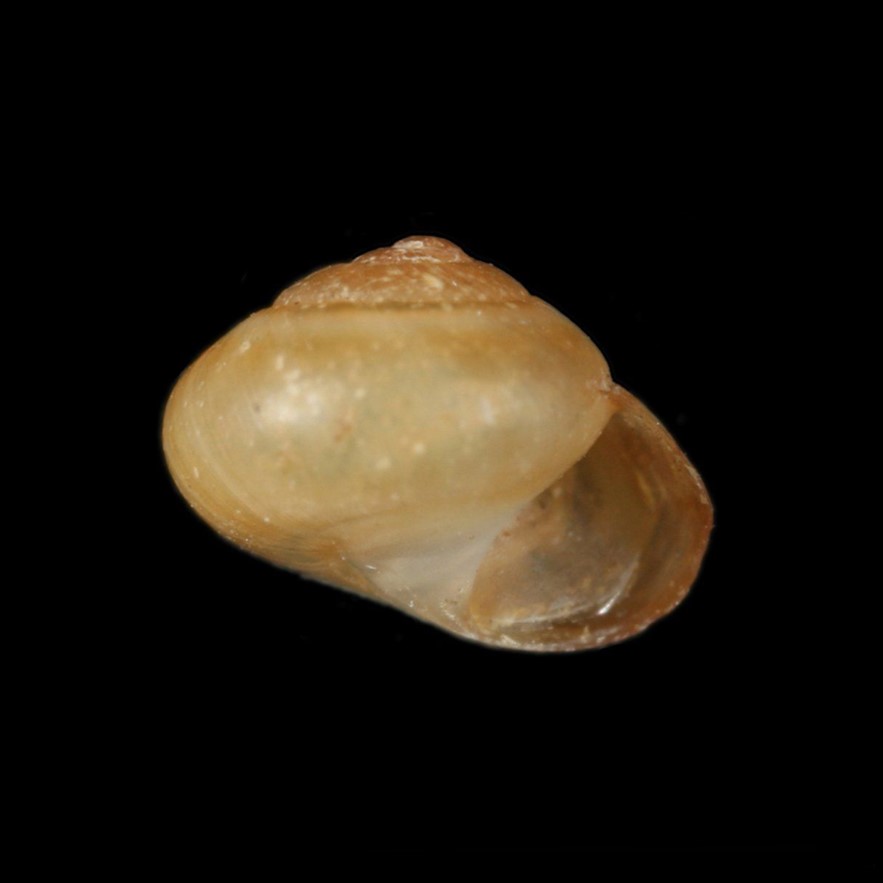
ESPÉCIE: Helicina nesiotica Dall, 1892
Tamanho médio: ~3mm
Habitat: vive árvores e arbustos
Ocorrência: Equador, Arquipélago de Galápagos (ilhas de Floreana, Isabela, San Cristóbal e Santa Cruz)
Localidade tipo: Equador, Arquipélago de Galápagos, Ilha de San Cristobal
Altitude: 490 m
Nome original: Helicina (Idesa) nesiotica Dall, 1892
Subespécies:
(i) Helicina nesiotica nesiotica Dall, 1892
(ii) Helicina nesiotica wolfi Reibisch, 1893
Descrição original:
(Dall 1896): “Shell small, depressed, with rounded periphery; spire depressed; suture very distinct, not channelled; base moderately convex; peristome not thickened nor relected; epidermis of a bright reddish chestnut, polished, but with obvious regular incremental lines; base with a thin white callus merging into the lower lip without notch or angle; operculum smooth, whitish, angulated only at the upper extreme”
Fotos: (1) National Museum of Natural History, Smithsonian Institution: LECTOTYPE de Helicina nesiotica nesiotica, USNM 107324, Equador, San Cristobal Island, 3.3mm
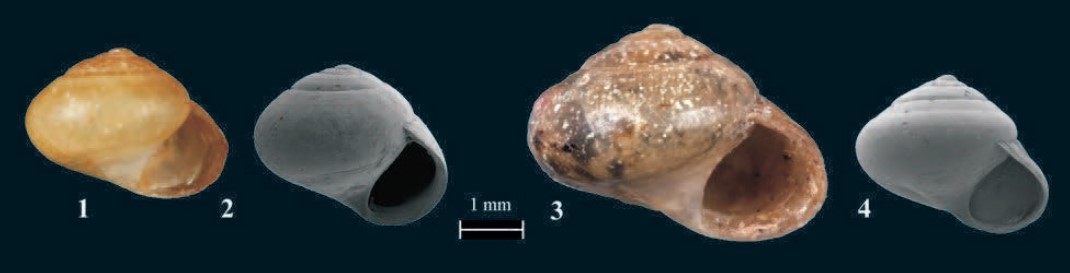
Figura: Miquel, S. E.; Herrera, H. W. (2014): (1–2) Helicina nesiotica Dall 1892; (1) LECTOTYPE USNM 107324, San Cristóbal Island; (2) ICCDRS 0036988, Floreana, Cerro Pajas; (3-4) Helicina ochsneri Dall 1917; (3) CAS-IZ 66448.00, LECTOTYPE, Isabela Island; (4) ICCDRS 0036566, Santa Cruz Island
Fontes:
Descrição original: (como Helicina (Idesa) nesiotica Dall, 1892) Dall, W. H. (1892). On some types new to the fauna of the Galápagos Islands. The Nautilus. 5(9): 97–99., disponível online em https://www.biodiversitylibrary.org/page/42788893
página(s): 97
Descrição original: (como Helicina wolfi Reibisch, 1893) Reibisch P. (1893 [“1892”]). Die conchyliologische Fauna der Galapagos-Inseln. Sitzungsberichte und Abhandlungen der Naturwissenschaftlichen Gesellschaft Isis in Dresden. 1892(3): 13-32., disponível online em https://www.biodiversitylibrary.org/page/53776884
página(s): 29
Miquel, S. E.; Herrera, H. W. (2014). Catalogue of terrestrial gastropods from Galápagos (except Bulimulidae and Succineidae) with description of a new species of Ambrosiella Odhner (Achatinellidae) (Mollusca: Gastropoda). Archiv für Molluskenkunde. 143(2): 107-133., disponível online em https://doi.org/10.1127/arch.moll/1869-0963/143/107-133
página(s): Figs 1–2, map 2
Wagner, A. J. (1907-1911). Die Familie der Helicinidae. In: Küster, H. C. & Kobelt, W., Eds., Systematisches Conchylien-Cabinet von Martini und Chemnitz, Neue Folge. Ersten Bandes, achtzehnte Abtheilung, zweiter Theil. 1-72, pls 1-12 (1907), 73-160, pls 13-30 (1908), 161-248, pls 31-48 (1909), 249-328, pls 49-66 (1910), 329-391, pls 67-70 (1911). Nürnberg (Bauer & Raspe)., disponível online em https://biodiversitylibrary.org/page/52348872
página(s): 45
Miquel, S. E. & Herrera, H. W. (2019). Contribution to the knowledge of selected land gastropods of Galápagos (Ecuador). Spixiana. 42(2): 185-191.
página(s): 186, Figs 2-5
Chambers, S. M. & Steadman, D. W. (1988). Holocene terrestrial gastropod faunas from Isla Santa Cruz and Isla Floreana, Galápagos: evidence for late Holocene declines. Transactions of the San Diego Society of Natural History. 21(6): 89-110, figs. 1, 2A-L, 3., disponível online em https://www.biodiversitylibrary.org/page/4287005
página(s): 94
Orrell T, Informatics and Data Science Center – Digital Stewardship (2026). NMNH Extant Specimen Records (USNM, US). Version 1.104. National Museum of Natural History, Smithsonian Institution. Occurrence dataset https://doi.org/10.15468/hnhrg3 accessed via GBIF.org on 2026-01-03. https://www.gbif.org/occurrence/1318334079
MolluscaBase: https://molluscabase.org/aphia.php?p=taxdetails&id=1306765

Vive em árvores e arbustos

Vive sob ou sobre pedras

Vive em corais ou recifes

Vive em algas marinhas

Vivem em fundos de cascalho de coral, pedra ou conchas

Vive no solo. Sob folhas ou enterada parte do tempo

Vive em fundos arenosos, enterrada ou sob ele.

Animais que nadam ou vivem livremente

Presos a certos animais ou parasitando

Vive em fundos lodosos

Vive em plantas de água doce

Seu habitat é desconhecido

Alimenta-se de plantas e algas

Alimenta-se de outros animais

Alimenta-se de qualquer fonte

Alimenta-se de animais mortos
Seu hábito alimentar é desconhecido


