
CLASSE: GASTROPODA: TERRESTRE
FAMÍLIA: SIMPULOPSIDAE
ESPÉCIE: Leiostracus onager (Beck, 1837)
Tamanho médio: 26 mm
Habitat: Mata Atlântica, provavelmente vive em árvores e arbustos, como de costume para o gênero
Ocorrência: Brasil (Bahia)
Localidade tipo: para o NEOTYPE: Itabuna, Bahia, ~54 m de altitude (E. Garbe col., viii.1900)
Comentário: NEOTYPE designado por Salvador & Cavallari, 2013
Nome original: Bulimus onager (Beck, 1837)
Sinônimos: Drymaeus (Leiostracus) onager Beck, 1837
Etimologia: nome da espécie vem do Latim “onagro“, que significa “burro selvagem”; provavelmente se referindo às listras na concha, como alguns burros selvagens mostram listras pretas nas pernas (lembrando também que outra espécie de Leiostracus, descrita por Spix, foi chamada de “zebra”)
Redescrição:
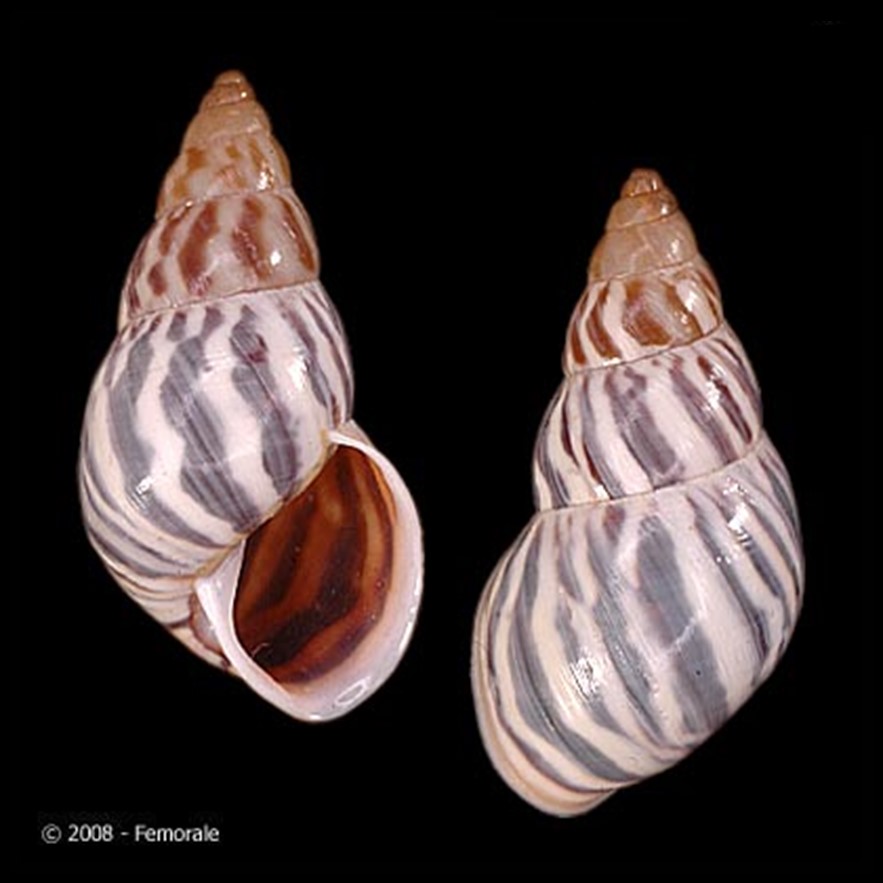
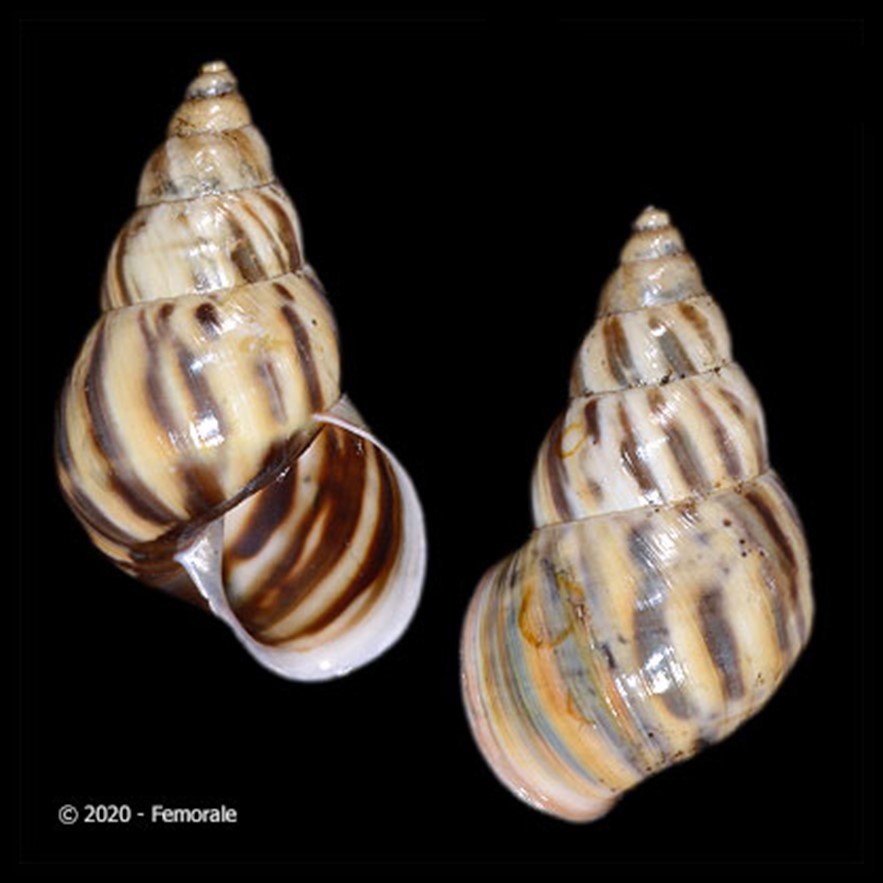
(Salvador & Cavallari, 2013): “Shell medium-sized, sub-conical; width ~1/2 shell length. Spire top colour (~2¾ whorls, including protoconch) whitish to light brownish yellow; remaining whorls white with thick brown axial bands, sometimes forked above. Colour pattern visible from the inside of shell; peristome white; region surrounding umbilicus brown (same colour as axial marks). Spire angle ~40°. Protoconch (~1½ whorls) sculptured by fine parallel axial wrinkles only on the topmost portion of whorls, but this sculpture soon stops and gives place to numerous very fine parallel spiral lines; transition to teleoconch unclear. Teleoconch smooth, except for growth lines.
Whorls profile slightly convex. Suture well-marked, slightly oblique (diagonal) to columellar axis. Aperture large, oval, slightly prosocline (~15º with columellar axis); ~1/2 shell length, ~2/3 shell width. Peristome reflected, especially on columellar region, partially covering umbilicus. Body whorl ~2/3 shell length. Umbilicus rimate.”
Fotos: (1,2) Leiostracus onager (Beck, 1837): cortesia Femorale, Bahia, 17 e 22mm respectivamente
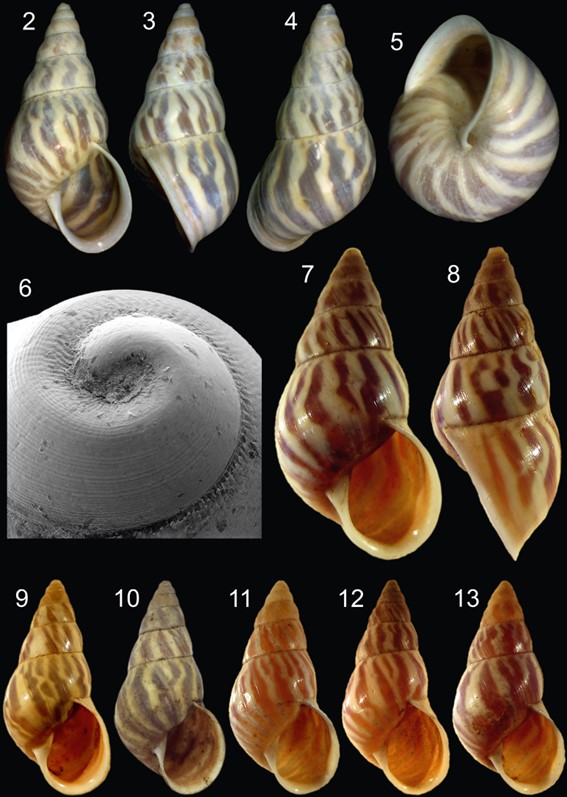
Figura: Salvador & Cavallari, 2013: Leiostracus onager. (2–5): NEOTYPE MZSP 29794, 25.6 mm; (6): SEM imagem da protoconcha, Museu Nacional de História Natural, Paris, MNHN IM-2012–2004; (7–8) MNHN IM-2012–2003, 21.5 mm; (9) MNHN IM-2012–2006, 23 mm; (10) LMD 115401b, 24 mm; (11) MNHN IM-2012– 2003, 22 mm; (12) MNHN IM-2012–2003, 23 mm; (13) MNHN IM-2012–2003, 22.5 mm
Fontes:
Descrição original: (como Bulimus (Bulimulus) onager Beck, 1837) Beck, H. (1837-1838). Index molluscorum praesentis aevi musei principis augustissimi Christiani Frederici. 124 pp. Hafniae [Copenhagen]. Pp. 1-100 [1837]; 101-124 [1838]; Appendix: 1-8 [June 1837]. , disponível online em https://biodiversitylibrary.org/page/32058074
página(s): 64
Simone, L. R. L. (2006). Land and Freshwater Molluscs of Brazil. Editora Gráfica Bernardi, FAPESP. São Paulo, 390 pp. página(s): 122, Fig. 383
Salvador, Rodrigo & Cavallari, Daniel. (2013). Taxonomic revision of Leiostracus onager and Leiostracus subtuszonatus (Gastropoda: Pulmonata: Orthalicidae). Journal of Conchology. 41. 511-518. disponível online em https://www.researchgate.net/publication/259150873_Taxonomic_revision_of_Leiostracus_onager_and_Leiostracus_subtuszonatus_Gastropoda_Pulmonata_Orthalicidae
MolluscaBase: https://www.molluscabase.org/aphia.php?p=taxdetails&id=1292071

Vive em árvores e arbustos

Vive sob ou sobre pedras

Vive em corais ou recifes

Vive em algas marinhas

Vivem em fundos de cascalho de coral, pedra ou conchas

Vive no solo. Sob folhas ou enterada parte do tempo

Vive em fundos arenosos, enterrada ou sob ele.

Animais que nadam ou vivem livremente

Presos a certos animais ou parasitando

Vive em fundos lodosos

Vive em plantas de água doce

Seu habitat é desconhecido

Alimenta-se de plantas e algas

Alimenta-se de outros animais

Alimenta-se de qualquer fonte

Alimenta-se de animais mortos
Seu hábito alimentar é desconhecido


