

CLASSE: GASTROPODA: TERRESTRE
FAMÍLIA: STROPHOCHEILIDAE
ESPÉCIE: Megalobulimus felipponei (Ihering, 1928)
Tamanho médio: 38.5 mm
Ocorrência: Uruguai, Brasil (Rio Grande do Sul)
Localidade tipo: Uruguai, Paysandú
Nome original: Strophocheilus felipponei Ihering, 1928
Etimologia: o nome da espécie é uma homenagem ao médico, botânico e biólogo uruguaio Florentino Felippone (1852-1939)
Comentários: (1) provável holótipo de Megalobulimus felipponei registrado no Museu de Zoologia de São Paulo – MZSP 5656, 40mm, Uruguai, Paysandú, coll. Felippone, 1908, enviado pelo Museum of Comparative Zoology, Cambridge, Massachusetts; (2) Salvador et al. 2024 não traz a ocorrência de Megalobulimus felipponei para o Brasil, porém diversos registros no iNaturalist tem sido classificados como sendo desta espécie no Estado do Rio Grande do Sul
Descrição original:
(Ihering, 1928): “Shell thin, slightly globose, coated with a periostracum, of a dark yellow color. The spire is short, the embryo shell is composed of four whorls, the first being smooth, the others densely covered with numerous and fine longitudinal ribs. In the following whorls, these fine ribs persist, and they reunite in groups close to the suture, merging into a small whitish plate.
The disposition of these plates at the side of the suture, causes an impression of a crinkling of the same, which, in general, happens with the species of the group Strophocheilus. The aperture is wide oval; the columela which is slightly convex, is thickened above in a doubling form, colored white, which forms an obtuse angle with the wall of the aperture, in which can be seen a terminal line of the callus. The position of the aperture is oblique.
The external lip is sharp but not reflexed. There is no visible vestige of the umbilical fissure. Evidently it is a new shell, which has almost reached its definite dimensions, taking into account that the species of this group do not, as a rule, have many more than 1 1/2 whorls in the post-embryonal shell.”
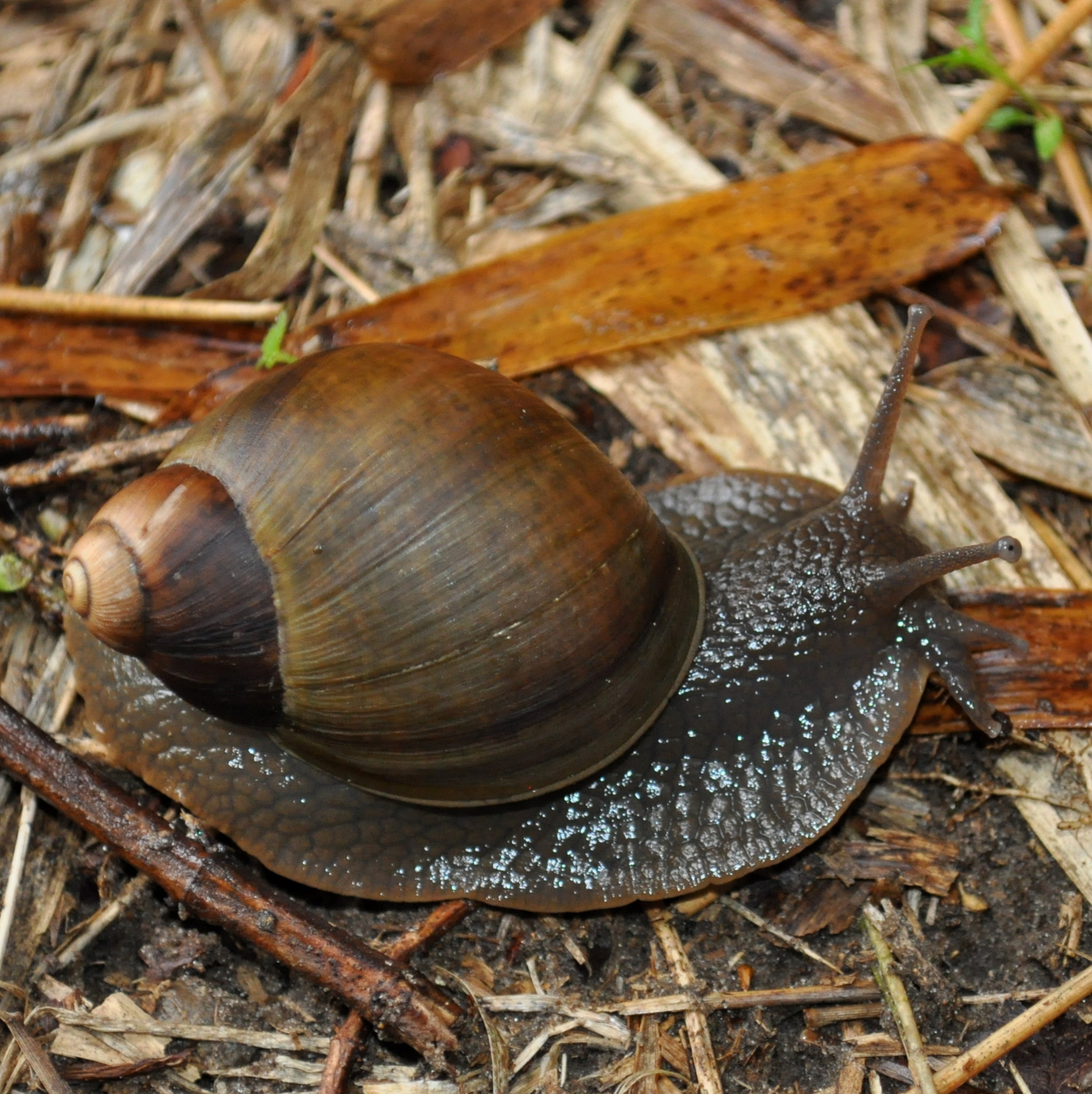
Fotos: (1) nd; (2) iNaturalist, observação 265346954, Arraia, Rio Grande, Rio Grande do Sul, Brasil, 17.ix.2019, crédito: Vinícius S. Domingos
Fontes:
Descrição original: (como Strophocheilus felipponei Ihering, 1928) Ihering, H. von. (1928). Two new species of shells from Uruguay. The Nautilus. 41(3): 95-97., disponível online em https://www.biodiversitylibrary.org/page/8519826
página(s): 96-97
Simone, L. R. L. (2006). Land and Freshwater Molluscs of Brazil. Editora Gráfica Bernardi, FAPESP. São Paulo, 390 pp.
página(s): 209
Simone, Luiz & Dornellas, Ana Paula. (2011). Annotated list of type specimens of mollusks deposited in Museu de Zoologia da Universidade de São Paulo, Brazil. Arquivos de Zoologia. 42. página(s) 1-81
Salvador, Rodrigo & Miranda, Marcel & Santos, Fernanda & Oliveira, Cléo & Arruda, Janine & Cavallari, Daniel & Gomes, Suzete & La Pasta, Ariel & Pena, Meire & Ovando, Ximena & Rosa, Rafael & Salles, Anna Caroline & Santos, Sonia & Simone, Luiz & Marcondes Machado, Fabrizio. (2024). Checklist of the terrestrial gastropods of Brazil. Journal of Conchology. 45. 142-185
Molluscabase: https://molluscabase.org/aphia.php?p=taxdetails&id=1448816

Vive em árvores e arbustos

Vive sob ou sobre pedras

Vive em corais ou recifes

Vive em algas marinhas

Vivem em fundos de cascalho de coral, pedra ou conchas

Vive no solo. Sob folhas ou enterada parte do tempo

Vive em fundos arenosos, enterrada ou sob ele.

Animais que nadam ou vivem livremente

Presos a certos animais ou parasitando

Vive em fundos lodosos

Vive em plantas de água doce

Seu habitat é desconhecido

Alimenta-se de plantas e algas

Alimenta-se de outros animais

Alimenta-se de qualquer fonte

Alimenta-se de animais mortos
Seu hábito alimentar é desconhecido


