

CLASSE: GASTROPODA: TERRESTRE
FAMÍLIA: BULIMULIDAE
ESPÉCIE: Mesembrinus vexillum (W. Wood, 1828)
Tamanho médio: 30 mm
Ocorrência: Peru (Cajamarca, Lambayeque)
Localidade tipo: não informado
Nome original: Helix vexillum W. Wood, 1828
Sinônimos: Bulimus keppelii L. Pfeiffer, 1853; Bulimus serenus R. A. Philippi, 1867; Bulimus vexillum (W. Wood, 1828); Bulinus pulchellus Broderip, 1832; Bulinus rubellus Broderip, 1832; Bulinus tigris Broderip, 1832; Bulinus varians Broderip, 1832; Drymaeus (Drymaeus) pulchellus (Broderip, 1832); Drymaeus (Drymaeus) vexillum (W. Wood, 1828); Drymaeus (Drymaeus) vexillum rubellus (Broderip, 1832); Drymaeus (Drymaeus) vexillum tigris (Broderip, 1832); Drymaeus (Drymaeus) vexillum varians (Broderip, 1832); Drymaeus (Drymaeus) vexillum vexillum (W. Wood, 1828); Drymaeus (Mesembrinus) serenus (R. A. Philippi, 1867); Drymaeus pulchellus (Broderip, 1832); Drymaeus serenus (R. A. Philippi, 1867); Drymaeus vexillum (W. Wood, 1828); Drymaeus vexillum rubellus (Broderip, 1832); Drymaeus vexillum tigris (Broderip, 1832); Drymaeus vexillum varians (Broderip, 1832); Drymaeus vexillum vexillum (W. Wood, 1828); Helix vexillum W. Wood, 1828; Mesembrinus serenus (R. A. Philippi, 1867)
Subespécies:
(1) Drymaeus vexillum rubellus (Broderip, 1832)
(2) Drymaeus vexillum tigris (Broderip, 1832)
(3) Drymaeus vexillum varians (Broderip, 1832)
(4) Drymaeus vexillum vexillum (W. Wood, 1828)
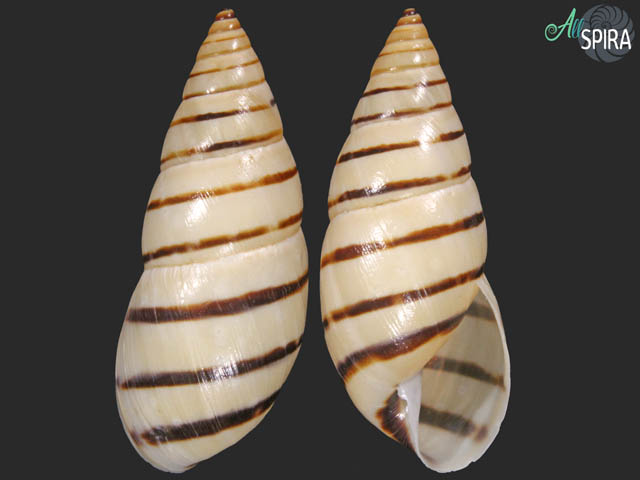
Fotos:
(1) Senckenberg Natural History Museum, Frankfurt: SYNTYPE de Drymaeus (Drymaeus) varians Broderip & Sowerby, 1832, SMF 10064, Peru, “In Peruviae montibus, Truxillo”, 30.0mm;
(2) Museu Nacional de História Natural, Paris: SYNTYPE de Bulinus rubellus Broderip, 1832, MNHN-IM-2000-28118, Coll. Férussac com Cuming & Parreys, “in Peruviae montibus (Truxillo)”, 28.7mm;
(3) Drymaeus vexillum rubellus “Peru, Áncash Region, from Huaraz to Casma”, 23.ii.2006, crédito: Claude and Amandine Evanno, 2018;
(4) cortesia Carles Dorado (Allspira), “Yonan, Contumazá Province, Dept. Cajamarca, North Perú”, 36.25mm

Fontes:
Descrição original: (como Helix vexillum W. Wood, 1828) Wood W. (1828). Index testaceologicus; or a catalogue of shells, British and foreign, arranged according to the Linnean system; with the Latin and English names, references to authors, and places where found. Ed. 2. London: the author. i-xxii, [1], 1-212, 38 pls. , disponível online em https://www.biodiversitylibrary.org/page/22493802
Descrição original: (como Bulinus rubellus Broderip, 1832) Broderip, W. J. (1832). New species of shells collected by Mr. Cuming on the western coast of south America and in the islands of the South Pacific Ocean. Proceedings of the Committee of Science and Correspondence of the Zoological Society of London. 2: 124-126., disponível online em https://www.biodiversitylibrary.org/page/12861722
página(s): 124
Descrição original: (como Bulimus serenus R. A. Philippi, 1867) Philippi, R. A. (1867). Descriptio brevis molluscorum quorundam terrestrium a clarissimo viro Antonio Raimondi in Peruvia lectorum. Malakozoologische Blätter. 14: 65-79. Cassel., disponível online em https://www.biodiversitylibrary.org/page/15855866
página(s): 72
Descrição original: (como Bulinus tigris Broderip, 1832) Broderip, W. J. & Sowerby, G. B. I. (1832-1833). [Descriptions of new species of shells from the collection formed by Mr. Cuming on the western coast of South America, and among the islands of the southern Pacific Ocean.]. Proceedings of the Committee of Science and correspondence of the Zoological Society of London. Part II for 1832: 25–33 [21 April 1832], 50-61 [5 June 1832], 104–108 [31 July 1832], 113–120 [14 August 1832]; 173–179 [14 Jan. 1833], 194–202 [13 March 1833]., disponível online em https://www.biodiversitylibrary.org/page/26730700
página(s): 107
Descrição original: (como Bulinus varians Broderip, 1832) Broderip, W. J. & Sowerby, G. B. I. (1832-1833). [Descriptions of new species of shells from the collection formed by Mr. Cuming on the western coast of South America, and among the islands of the southern Pacific Ocean.]. Proceedings of the Committee of Science and correspondence of the Zoological Society of London. Part II for 1832: 25–33 [21 April 1832], 50-61 [5 June 1832], 104–108 [31 July 1832], 113–120 [14 August 1832]; 173–179 [14 Jan. 1833], 194–202 [13 March 1833]., disponível online em https://www.biodiversitylibrary.org/page/26730700
página(s): 107
Descrição original: (como Bulinus pulchellus Broderip, 1832) Broderip, W. J. & Sowerby, G. B. I. (1832-1833). [Descriptions of new species of shells from the collection formed by Mr. Cuming on the western coast of South America, and among the islands of the southern Pacific Ocean.]. Proceedings of the Committee of Science and correspondence of the Zoological Society of London. Part II for 1832: 25–33 [21 April 1832], 50-61 [5 June 1832], 104–108 [31 July 1832], 113–120 [14 August 1832]; 173–179 [14 Jan. 1833], 194–202 [13 March 1833]., disponível online em https://www.biodiversitylibrary.org/page/26730700
página(s): 106
Pilsbry, H. A. (1932). South American land and freshwater mollusks, 8. Collections of the Carriker-Roberts Peruvian expedition of 1932. Proceedings of the Academy of Natural Sciences of Philadelphia. 84: 387-402
Breure, A. S. H.; Oroño, E. S.; Ablett, J. D.; Vega-Luz, R.; Ávila, V. M. (2024). Struggling with shells: Drymaeus Albers, 1850 and Mesembrinus Albers, 1850 species (Mollusca, Gastropoda, Bulimulidae) from Peru—an illustrated checklist and descriptions of new species. Journal of Conchology. 42(2): 293-367., disponível online em https://doi.org/10.61733/jconch/4530
Salvador, R. B.; Silva, F. S.; Cavallari, D. C.; Köhler, F.; Slapcinsky, J.; Breure, A. S. H. (2023). Molecular phylogeny of the Orthalicoidea land snails: Further support and surprises. PlosOne. 18(7): e0288533., disponível online em https://doi.org/10.1371/journal.pone.0288533
MolluscaBase: https://www.molluscabase.org/aphia.php?p=taxdetails&id=1456236

Vive em árvores e arbustos

Vive sob ou sobre pedras

Vive em corais ou recifes

Vive em algas marinhas

Vivem em fundos de cascalho de coral, pedra ou conchas

Vive no solo. Sob folhas ou enterada parte do tempo

Vive em fundos arenosos, enterrada ou sob ele.

Animais que nadam ou vivem livremente

Presos a certos animais ou parasitando

Vive em fundos lodosos

Vive em plantas de água doce

Seu habitat é desconhecido

Alimenta-se de plantas e algas

Alimenta-se de outros animais

Alimenta-se de qualquer fonte

Alimenta-se de animais mortos
Seu hábito alimentar é desconhecido


