

CLASSE: GASTROPODA: TERRESTRE
FAMÍLIA: STROPHOCHEILIDAE
ESPÉCIE: Mirinaba erythrosoma (Pilsbry, 1895)
Tamanho médio: 52 – 65 mm
Habitat: vive no solo, sob folhas ou enterrada parte do tempo
Alimentação: herbívoro
Ocorrência: Brasil (Paraná, Santa Catarina, Rio Grande do Sul)
Sinônimos: Strophocheilus erythrosoma Pilsbry, 1895; Strophocheilus porphyrostoma Clench & Archer, 1930
Descrição original:
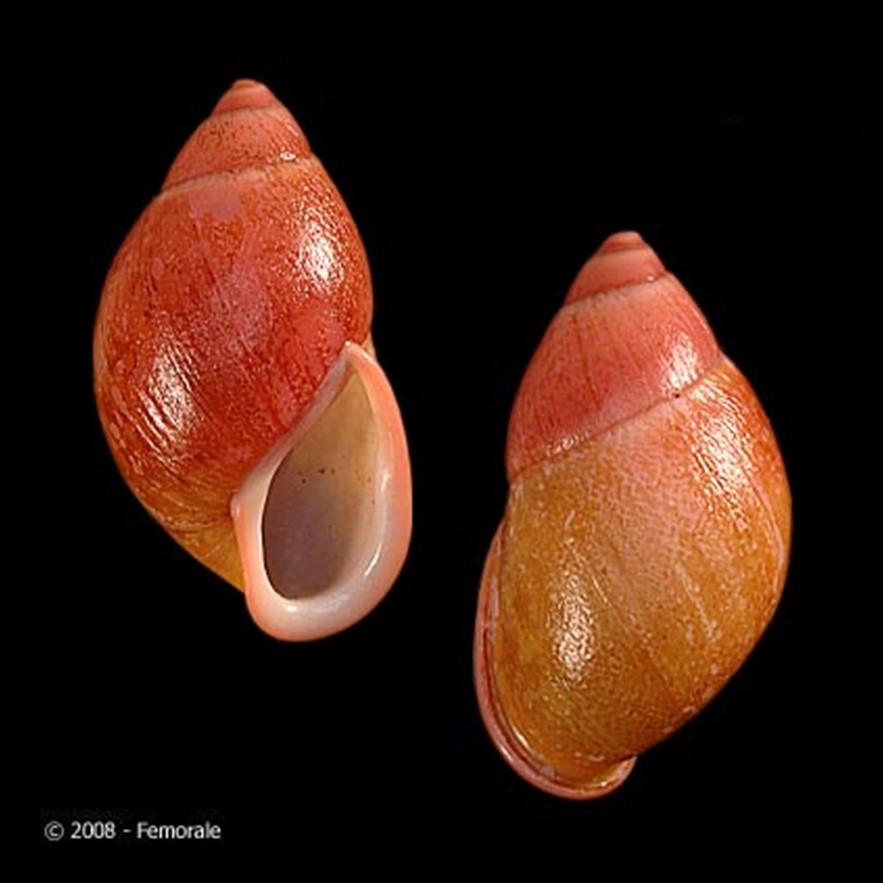
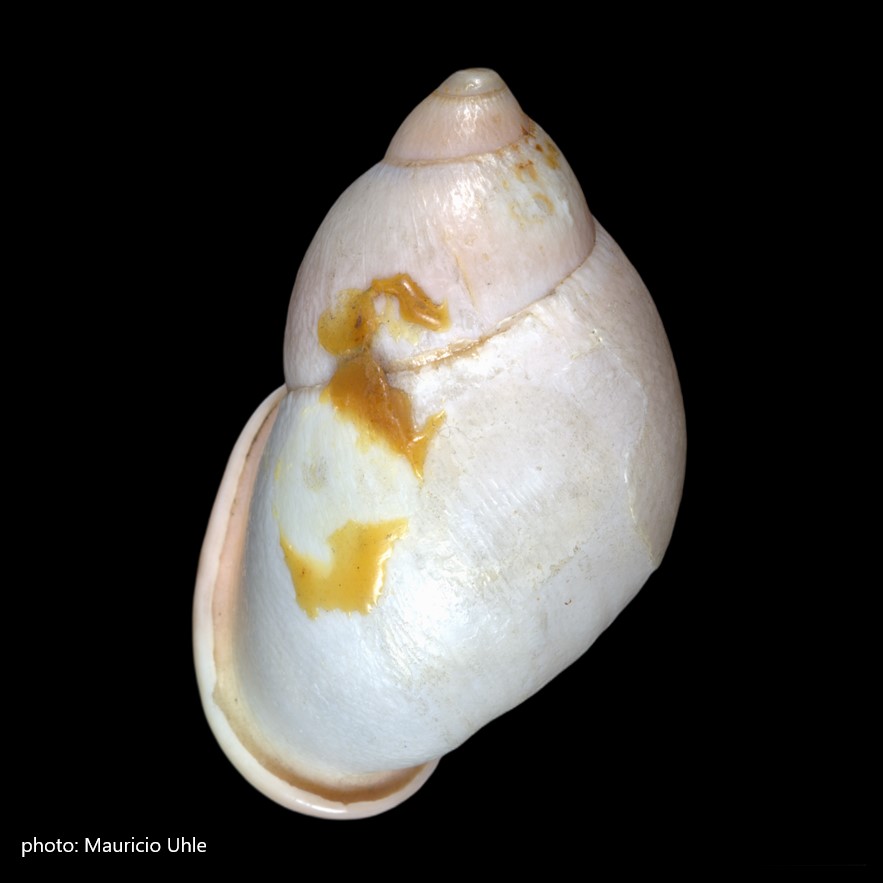
(Pilsbry, 1895): “Shell nearly imperforate, ovate, solid and strong; part roseate, part white under a yellow cuticle. Surface having inconspicuous growth-lines, a fine, shallow malleation, and dense, microscopic spiral striation. Whorls 4 3/4, the first planorboid, the last obliquely descending.
Aperture oblique, small and narrow, somewhat over half the shell’s length, white inside; peristome reflexed, recurved, thick, rounded on the face, rose-color, but white at the outer-basal portion; there is a perceptible thickening at the middle of the outer lip, but no tooth. Columella roseate, narrow below, reflexed and recurved, hardly widened above, and foldless.
Parietal callus heavy, rose-colored toward the margin, white within, the white extending upon the inner, upper part of columella. Alt. 53, diam. 28 mill.; aperture measured outside peristome, alt. 28, width 18 mill. Brazil (J. G. Anthony).
Differs from Strophocheilus pudicus in the micro-sculpture, thick lip and narrow aperture; from planidens and milleri in the malleation, etc. It is more nearly allied to unidentatus, which has the same sculpture, but the spire is slenderer and more produced, mouth narrower, lip not dentate and differently colored.”
Fotos: (1) cortesia Femorale, 2008, Iporanga, São Paulo, 56 mm; (2,3) The Academy of Natural Sciences, Philadelphia: PARALECTOTYPE de Mirinaba erythrosoma, ANSP 426226, doador: Anthony, J.G., (“split from ANSP 30341, J. Leme, 17.vii.1990”), foto: Mauricio Uhle; (5) Claude and Amandine EVANNO, 2018, Iguape, São Paulo, 59.6mm

Fontes:
Descrição original (como Strophocheilus erythrosoma Pilsbry, 1895) Pilsbry, H. A. (1895-1896). Manual of conchology, structural and systematic, with illustrations of the species. Ser. 2, Pulmonata. Vol. 10: American Bulimi and Bulimuli. Streptocheilus, Plekocheilus, Auris, Bulimulus. pp i-iv, 1-213, pls 1-51. Philadelphia, published by the Conchological Section, Academy of Natural Sciences. [pp. 1-48, Pl. 2-15, 20 Aug 1895; pp. 49-96, Pl. 16-30, 26 Nov 1895; pp. 97-144, Pl. 31-40, 13 Mar 1996; pp. 145-213, i-iv, title page, Pl. 1, Pl. 41-51, 23 Sep 1896]., disponível online em https://www.biodiversitylibrary.org/page/1100575
página(s): 10, pl. 22, figs 51-52
Descrição original (como Strophocheilus (Strophocheilus) porphyrostoma Clench & Archer, 1930) Clench, W. J. & Archer, A. F. (1930). A new species of Strophocheilus from Brazil. The Nautilus. 43(3): 75-77, text-figs. 1-3., disponível online em https://www.biodiversitylibrary.org/page/8515125
Simone, L. R. L. (2006). Land and Freshwater Molluscs of Brazil. Editora Gráfica Bernardi, FAPESP. São Paulo, 390 pp. página(s): 204
Molluscabase: https://www.molluscabase.org/aphia.php?p=taxdetails&id=1448741

Vive em árvores e arbustos

Vive sob ou sobre pedras

Vive em corais ou recifes

Vive em algas marinhas

Vivem em fundos de cascalho de coral, pedra ou conchas

Vive no solo. Sob folhas ou enterada parte do tempo

Vive em fundos arenosos, enterrada ou sob ele.

Animais que nadam ou vivem livremente

Presos a certos animais ou parasitando

Vive em fundos lodosos

Vive em plantas de água doce

Seu habitat é desconhecido

Alimenta-se de plantas e algas

Alimenta-se de outros animais

Alimenta-se de qualquer fonte

Alimenta-se de animais mortos
Seu hábito alimentar é desconhecido


