CLASSE: GASTROPODA: TERRESTRE
FAMÍLIA: ODONTOSTOMIDAE
ESPÉCIE: Odontostomus thielei (Pilsbry, 1930)
Tamanho médio: 40 mm
Ocorrência: Brasil, Paraguai
Localidade tipo: “Brasil”
Nome original: Macrodontes thielei Pilsbry, 1930
Sinônimos: Simone, 2006 considera a espécie Odontostomus thielei válida, porém em Salvador et al. 2024 a espécie é considerada sinônimo de Odontostomus gargantua (A. Férussac, 1821). Para efeitos de comparação, a espécie foi mantida
Etimologia: o nome da espécie é uma homenagem ao malacologista alemão Johannes Thiele (1860-1935)
Descrição original:
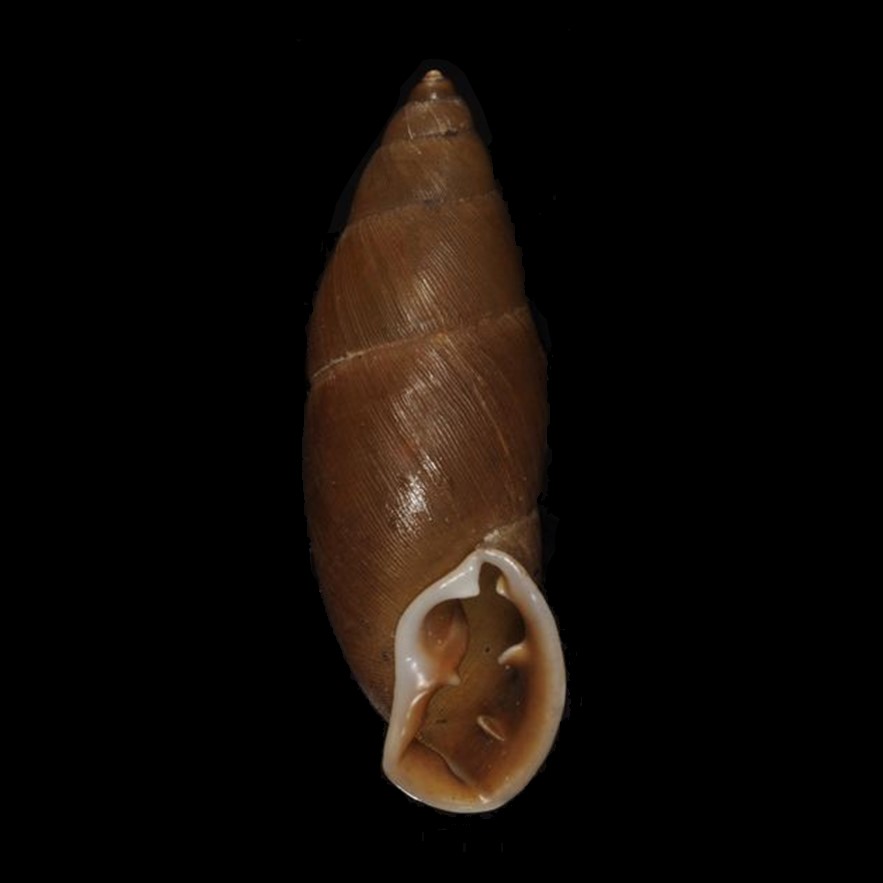
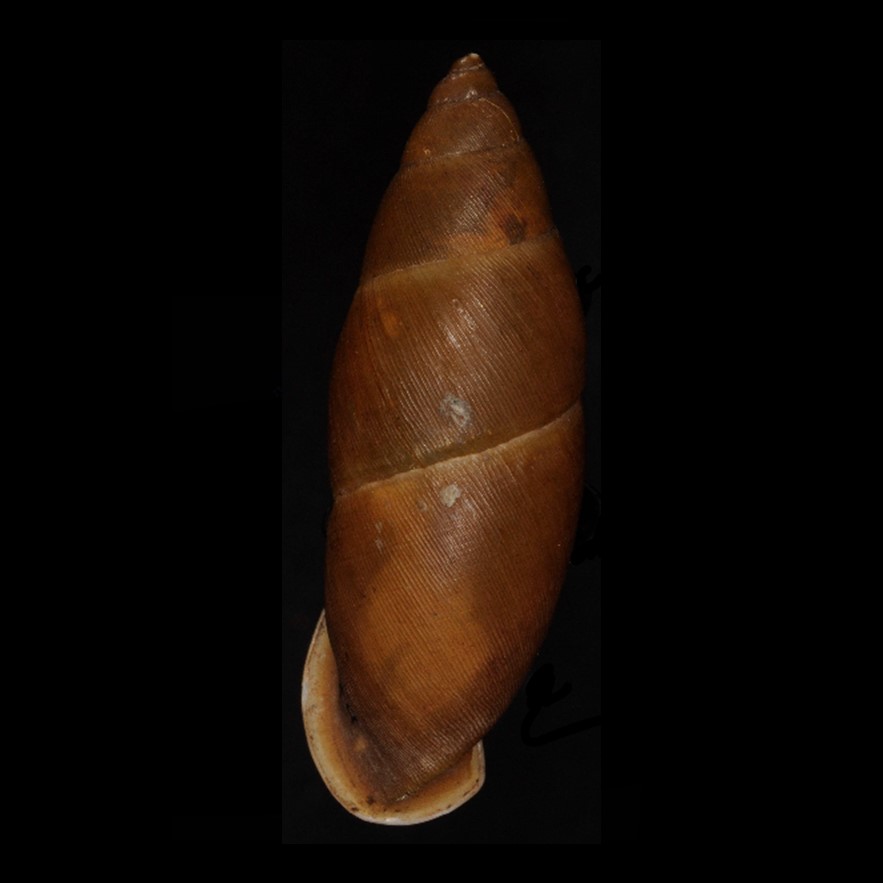
(Pilsbry, 1930): “The shell is obesely fusiform, moderately strong, russet with a narrow yellowish band accompanying the suture. The first 13F whorls are glossy and spirally striate, the remaining surface is matt, very finely and closely, obliquely striate, with extremely fine close and subobsolete spiral lines, which become more distinct on the last half whorl. The whorls are convex at first, the last two or three very weakly so. Last whorl becomes shortly detached in front, and has a strong basal keel in its last half; it is broadly but weakly contracted behind the outer lip, with three shallow pits over the teeth, that corresponding to the lower palatal tooth being very slight.
Behind the columella there is a very narrow, short umbilical slit bounded by a nearly concealed keel. The aperture is oblique, dusky russet within. Peristome is rather widely reflected, russet in the outer and basal margins, the parietal and part of columellar margins white.
There is a slight angulation at the outer-basal part, and a decided angle at junction of the straight basal margin with the columellar margin, at the termination of the umbilical keel. There is a triangular parietal “lamella,” a strong columellar lamella bearing a transverse tooth, below it a small subcolumellar. The outer lip has three teeth: a small suprapalatal, lengthened in the axial direction, a sharp, short, upper palatal entering diagonally downward, and a shorter lower palatal, ascending a little as it enters. Within the basal margin there is a low, obtuse callus, the place of which is indicated externally by a very shallow pit on the left side of the basal keel.”
Fotos: The Academy of Natural Sciences, Philadelphia: SYNTYPE de Macrodontes thielei Pilsbry, 1930, ANSP 152289, doador: H. von Ihering, 41.2 mm
Fontes:
Descrição original: Pilsbry, H. A. (1930). South American Land and Freshwater Mollusks: Notes and Descriptions: VII. Proceedings of the Academy of Natural Sciences of Philadelphia, 82, 355–365 http://www.jstor.org/stable/4064082
Pilsbry, H. A. (1898). New species of Odontostomus from Brazil and Argentina. Proceedings of the Academy of Natural Sciences of Philadelphia. 50: 471-474. página(s): 472
Simone, L. R. L. (2006). Land and Freshwater Molluscs of Brazil. Editora Gráfica Bernardi, FAPESP. São Paulo, 390 pp. página(s): 164
Rodrigo B. Salvador, Marcel S. Miranda, Fernanda S. Silva, Cléo D. C. Oliveira, Janine O. Arruda, Daniel C. Cavallari, Suzete R. Gomes, Ariel La Pasta, Meire S. Pena, Ximena M. C. Ovando, Rafael M. Rosa, Anna C. A. Salles, Sonia B. Santos, Luiz R. L. Simone & Fabrizio M. Machado (2024). Checklist of the terrestrial gastropods of Brazil. Journal of Conchology 45 (2), disponível online em https://conchsoc.org/jconch-45-2
Molluscabase: https://www.molluscabase.org/aphia.php?p=taxdetails&id=1289895