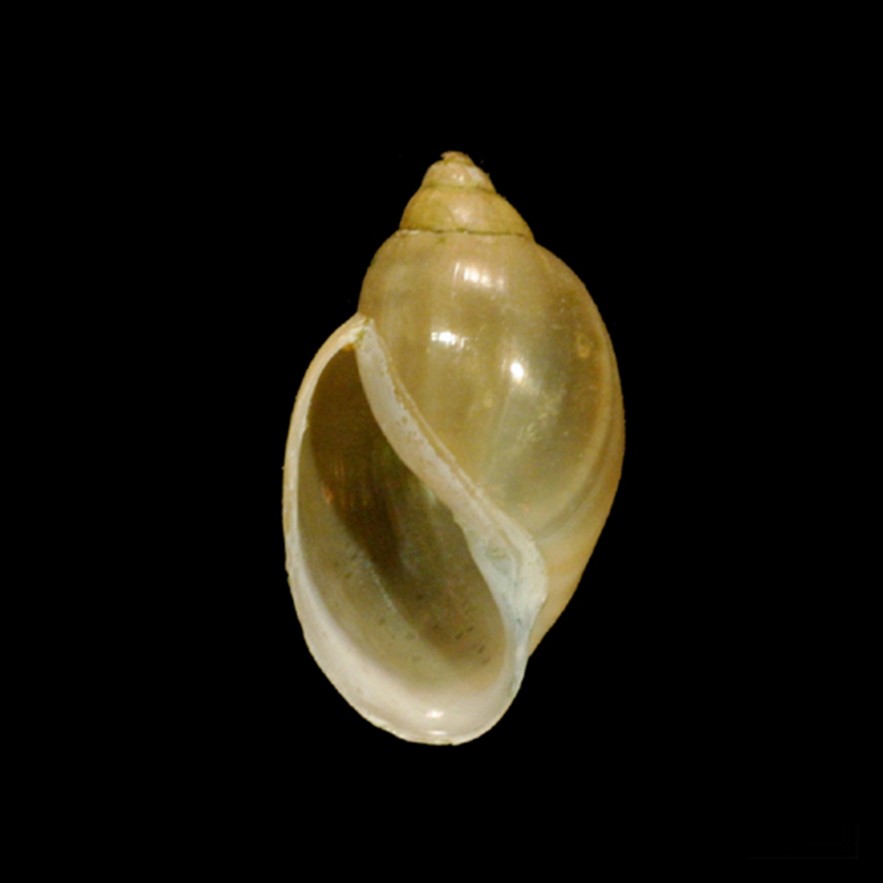
CLASSE: GASTROPODA: ÁGUA DOCE
FAMÍLIA: PHYSIDAE
ESPÉCIE: Physella acuta (Draparnaud, 1805) – ESPÉCIE INVASORA
Tamanho médio: 10 mm
Ocorrência: detectado no Brasil, inicialmente no Rio de Janeiro; já ocorre em todos os continentes
Localidade Tipo: nd
Nome original: Physa acuta Draparnaud, 1805
Sinônimos: Physella cubensis (L. Pfeiffer, 1839); Physella integra (Haldeman, 1841); Physella mexicana (R. A. Philippi, 1841); Physella virgata (Gould, 1855) entre outros
Fotos: (1) Collection of Natural History Museum Rotterdam, NMR 54888, 8mm
Fontes:
Descrição original: (como Physa acuta Draparnaud, 1805) Draparnaud, J.-P.-R. (1805). Histoire naturelle des mollusques terrestres et fluviatiles de la France. 2 pp. (Avertissement a sa Majesté l’Impératrice), 2 pp. Rapport, i-viii (Préface), 1-164, pl. 1-13, 1 p. Errata. [< 22 September]. Paris (Levrault & Schoell)., disponível online em https://www.biodiversitylibrary.org/page/52682088
página(s): 55
Descrição original: (como Physa cubensis L. Pfeiffer, 1839) Pfeiffer, L. (1839). Bericht über die Ergebnisse meiner Reise nach Cuba im Winter 1838-1839. Archiv für Naturgeschichte. 5(1): 346-358., disponível online em https://www.biodiversitylibrary.org/page/24904257
página(s): 354
Simone, L. R. L. (2006). Land and Freshwater Molluscs of Brazil. Editora Gráfica Bernardi, FAPESP. São Paulo, 390 pp.
página(s): 307
Miyahira, I. C., Gonçalves, I. C. B., Lacerda, L. E. M., Ximenes, R. F., & Santos, S. B.. (2023). The introduction of Physa acuta (Gastropoda: Physidae) on Ilha Grande, Southeast Brazil, from initial stages to an established population. Brazilian Journal of Biology, 83, e243801, disponível online em https://doi.org/10.1590/1519-6984.243801
Breure, Bram & Ablett, Jonathan & Roosen, Marijn. (2022). Land and freshwater molluscs of mainland Ecuador: an illustrated checklist. 40. 1-290
EBBS, E.T., LOKER, E.S. and BRANT, S.V., 2018. Phylogeography and genetics of the globally invasive snail Physa acuta Draparnaud 1805, and its potential to serve as an intermediate host to larval digenetic trematodes. BMC Evolutionary Biology, vol. 18, no. 1, pp. 103. http://dx.doi.org/10.1186/s12862-018-1208-z PMid:29969987.
» http://dx.doi.org/10.1186/s12862-018-1208-z
MIYAHIRA, I.C., PEREIRA, L.S. and SANTOS, L.N., 2020. Non-native freshwater molluscs in the Neotropics: what can be learned from Brazilian reservoirs? Aquatic Invasions, vol. 15, no. 3, pp. 455-472. http://dx.doi.org/10.3391/ai.2020.15.3.06
» http://dx.doi.org/10.3391/ai.2020.15.3.06
PARAENSE, W.L. and POINTIER, J.P., 2003. Physa acuta Draparnaud, 1805 (Gastropoda: Physidae): a study of topotypic specimens. Memórias do Instituto Oswaldo Cruz, vol. 98, no. 4, pp. 513-517. http://dx.doi.org/10.1590/S0074-02762003000400016 PMid:12937765.
» http://dx.doi.org/10.1590/S0074-02762003000400016
Molluscabase: https://molluscabase.org/aphia.php?p=taxdetails&id=234093