

CLASSE: GASTROPODA: TERRESTRE
FAMÍLIA: CLAUSILIIDAE
ESPÉCIE: Symptychiella acuminata H. Nordsieck, 2010
Tamanho médio: 16.2–19.6 mm
Ocorrência: Peru (San Martin)
Localidade tipo: Peru, San Martin, “path from Nueva Cajamarca to Cerro Mirador”
Altitude: 925 m
Nome original: Symptychiella (Symptychiella) acuminata H. Nordsieck, 2010
Etimologia: o nome da espécie é uma referência ao formato da concha: Do Latim “acuminatus” = pontiagudo (= pointed)
Descrição original:
(Nordsieck, 2010): “Shell with more or less attenuated apical part, whorls rounded, protoconch broader than following whorls; yellowish-brown to -grey, in part yellowish-white; teleoconch whorls densely rib-striated, on the neck rib-striation more irregular and in part stronger; neck rounded, somewhat compressed below, subsutural swelling developed behind; aperture descending, piriform, in part more rhombic, white to yellowish-brown within, in part white, peristome hardly expanded; superior lamella of different length and height, rarely nearly missing; inferior lamella high in position, ascending with a weak spiral, mostly moderately high inwards, in front ending on or near to the columellar edge,
inner part of inferior lamella indistinctly connected with inferior lamella, beside connection of both parts (inner) rudiment of spiral lamella developed as weak plica or indistinct; subcolumellar lamella descending to the lunellar, lower end separated from lunella; lunellar dorsolateral in position, occasionally dorsolateral-lateral; upper palatal plica of different strength, rarely nearly missing together with lunella, lunella ± distinct below, more or less weakened above, somewhat curved and ± connected with upper palatal plica, rudiment of principal plica missing (rarely indistinct); clausilium plate in oblique view fully visible, rarely less, distally with outer corner, mostly not leaving gaps, only occasionally at the palatal side.”
Fotos: (1) Forschungsinstitut und Naturmuseum Senckenberg: HOLOTYPE de Symptychiella acuminata , SMF 330878, Peru, “Dept. San Martin, path from Nueva Cajamarca to Cerro Mirador (ca. 925 m)”, 13.x.2007, leg. Hemmen, 17.4mm
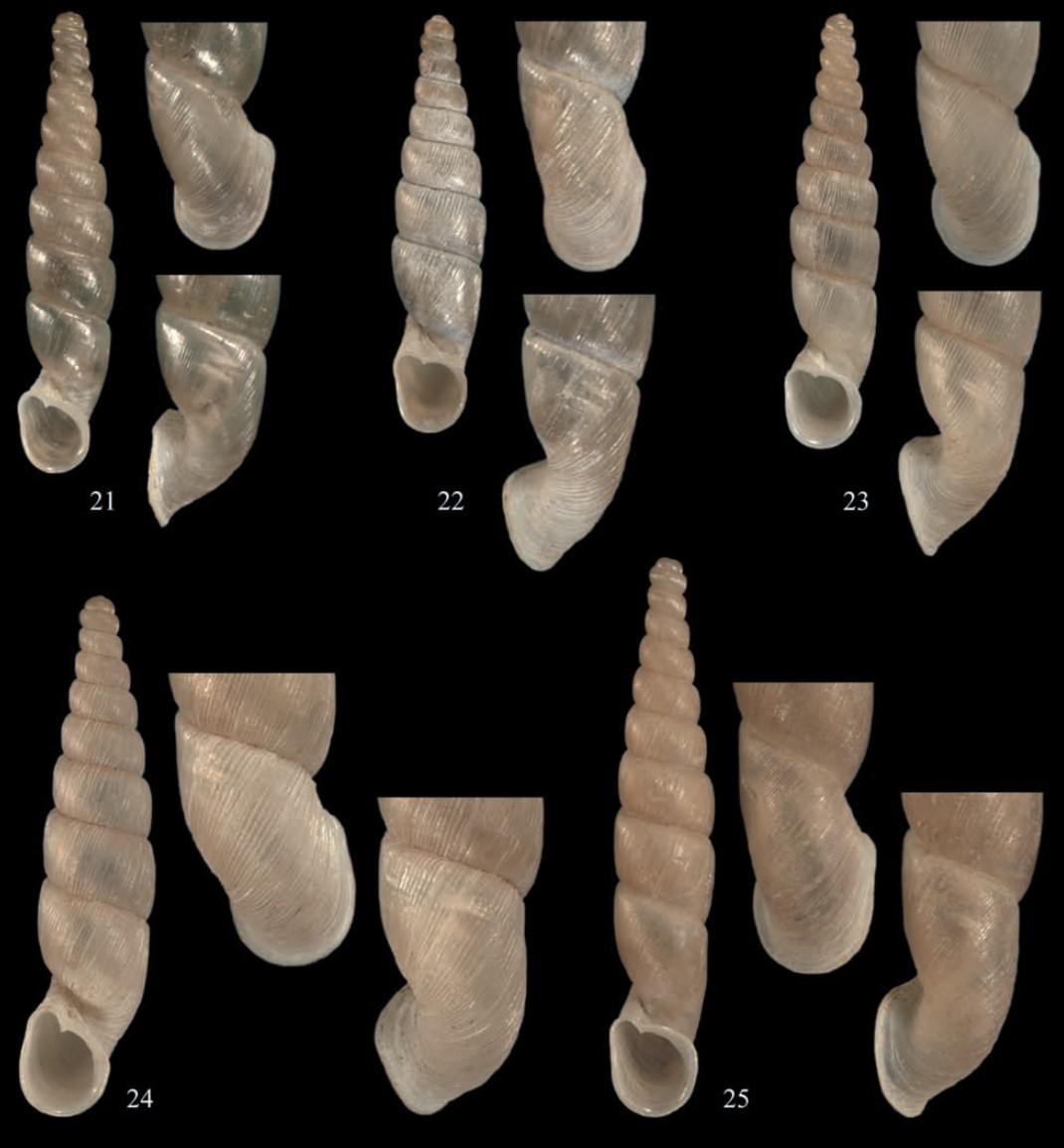
Figura: Nordsieck, 2010:
(21) Symptychiella bilamellata laevigata, HOLOTYPE SMF 329326, “Peru, Dept. San Martin, from Aguas Claras to Cuevas de Aguas Claras (1020 m)”, 22.i.2007, leg. Hemmen, 14.35 mm;
(22) Symptychiella bilamellata costulata, HOLOTYPE SMF 330169a, “Peru, Dept. San Martin, Cueva Aguas Verdes (1140 m)”, 24.i.2007, leg. Hemmen, 13.0 mm;
(23) Symptychiella bilamellata gracilicosta, HOLOTYPE SMF 330877, “Peru, Dept. San Martin, Cueva Huacharos de la Encanada (910 m)”, 6.x.2007, leg. Hemmen, 13.65 mm;
(24) Symptychiella fratermajor, HOLOTYPE SMF 329324, “Peru, Dept. San Martin, from Aguas Claras to Cuevas de Aguas Claras (950 m)”, 12.X.2007, leg. Hemmen, 16.2 mm;
(25) Symptychiella acuminata, HOLOTYPE SMF 330878, “Peru, Dept. San Martin, from Nueva Cajamarca to Cerro Mirador (925 m)”, 13.x.2007, leg. Hemmen, 17.4 mm
Fontes:
Descrição original: (como Symptychiella (Symptychiella) acuminata H. Nordsieck, 2010) Nordsieck, H. (2010). New taxa of the subfamilies Neniinae and Garnieriinae (Gastropoda: Stylommatophora: Clausiliidae). Archiv für Molluskenkunde, 139 (1): 45-69, 4 pls. Frankfurt am Main.
página(s): 58, fig. 25
Senckenberg. Collection Mollusca SMF. Occurrence dataset https://doi.org/10.15468/ohuexz accessed via GBIF.org on 2025-12-12. https://www.gbif.org/occurrence/318506775
Molluscabase: https://molluscabase.org/aphia.php?p=taxdetails&id=1291561

Vive em árvores e arbustos

Vive sob ou sobre pedras

Vive em corais ou recifes

Vive em algas marinhas

Vivem em fundos de cascalho de coral, pedra ou conchas

Vive no solo. Sob folhas ou enterada parte do tempo

Vive em fundos arenosos, enterrada ou sob ele.

Animais que nadam ou vivem livremente

Presos a certos animais ou parasitando

Vive em fundos lodosos

Vive em plantas de água doce

Seu habitat é desconhecido

Alimenta-se de plantas e algas

Alimenta-se de outros animais

Alimenta-se de qualquer fonte

Alimenta-se de animais mortos
Seu hábito alimentar é desconhecido


