

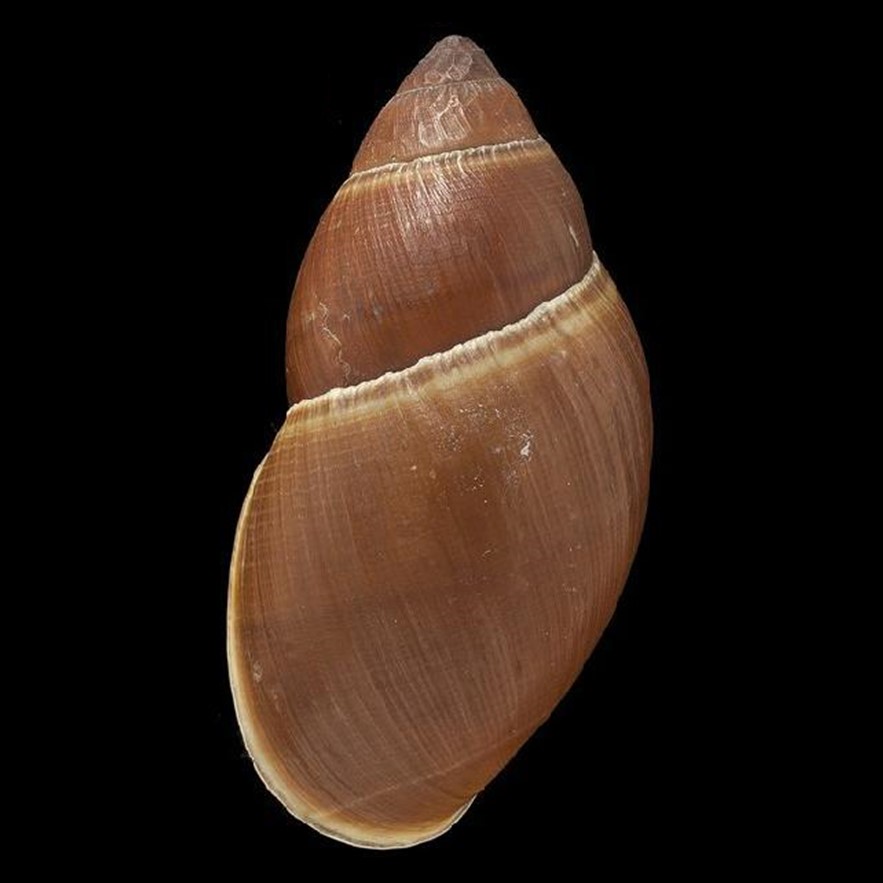
CLASSE: GASTROPODA: TERRESTRE
FAMÍLIA: MEGASPIRIDAE
ESPÉCIE: Thaumastus foveolatus (Reeve, 1849)
Tamanho médio: 86 mm
Ocorrência: Peru, Departamento de Junín, próximo a Tarma, Mito, 19.5 km WNW San Ramón (Breure 1978)
Localidade tipo: “Vitoe, near Sarma [sic, Tarma], Alto-Peru“
Nome original: Bulimus foveolatus Reeve, 1849
Sinônimos: Bulimus (Orphnus) foveolatus Reeve, 1849; Bulimus impressus Tschudi, 1852; Bulimus mahogani L. Pfeiffer, 1841; Thaumastus (Thaumastus) foveolatus (Reeve, 1849)
Fotos: (1-3) Natural History Museum, London: LECTOTYPE de Thaumastus foveolatus, NHMUK 1975275, coll. Hugh Cuming


Figura: Breure & Araujo (2017): (A) Megaspira elatior (Spix in Wagner, 1827), MNCN 15.05/19283; (B) Thaumastus (Thaumastiella) cf. koepckei Zilch, 1953, MNCN 15.05/13501; (C) Thaumastus (Thaumastus) achilles (Pfeiffer, 1853), MNCN 15.05/13299; (D) Thaumastus (Thaumastus) cf. orcesi Weyrauch, 1967, MNCN 15.05/7567; (E) Thaumastus foveolatus (Reeve, 1849), MNCN 15.05/13497; (F) Thaumastus (Thaumastus) hartwegi (Pfeiffer in Philippi, 1846), MNCN 15.05/13507. Escala 1 cm
Fontes:
Descrição original: (como Bulimus foveolatus Reeve, 1849) Reeve, L. A. (1848-1850). Monograph of the genus Bulimus. In: Conchologia Iconica, or, illustrations of the shells of molluscous animals, , vol. 5, pls. 1–89 and unpaginated text. L. Reeve & Co., London [pls. 1-9, Apr. 1848; 10-12, 15-19, May 1848; 13, 14, 20-25, Jun. 1848; 26-33, Jul. 1848; 34, 35, Aug. 1848; 36, 37, Sept. 1848; 38-45, Oct. 1848; 46-53, Nov. 1848; 54-57, Dec. 1848; 58-61, Jan. 1849; 62-64, Mar. 1849; 65-69, May 1849; 70-73, 75, Jul. 1849; 74, 76, 77, Aug. 1849; 78, 79, Sept. 1849 78-79; pls. 80-84, Dec. 1849; pls. 85-89, Feb. 1850]. , disponível online em https://www.biodiversitylibrary.org/page/8966758
página(s): pl. 73 fig. 526
Descrição original: (como Bulimus impressus Tschudi, 1852) Troschel, F. H. (1852). Verzeichniss der durch Hernn Dr. v. Tschudi in Peru gesammelten Conchylien. Archiv für Naturgeschichte. 18(1): 151-208., disponível online em https://www.biodiversitylibrary.org/page/7061138
página(s): 188
Descrição original: (como Bulimus mahogani L. Pfeiffer, 1841) Pfeiffer, L. (1841). Symbolae ad historiam Heliceorum. Sectio prima [vol. 1]. Kassel: Th. Fischer. 88 pp. , disponível online em https://biodiversitylibrary.org/page/12254132
página(s): 42
Breure, A. S. H. & Ablett, J. D. (2015). Annotated type catalogue of the Megaspiridae, Orthalicidae, and Simpulopsidae (Mollusca, Gastropoda, Orthalicoidea) in the Natural History Museum, London. ZooKeys. 470: 17-143.,disponível online em https://doi.org/10.3897/zookeys.470.8548
página(s): 31
Breure, A. S. H. & Araujo, R. (2017). The Neotropical land snails (Mollusca, Gastropoda) collected by the “Comisión Científica del Pacífico.”. PeerJ. 5, e3065., disponível online em https://www.ncbi.nlm.nih.gov/pmc/articles/PMC5354113/#
página(s): 35
MolluscaBase: https://molluscabase.org/aphia.php?p=taxdetails&id=1308979

Vive em árvores e arbustos

Vive sob ou sobre pedras

Vive em corais ou recifes

Vive em algas marinhas

Vivem em fundos de cascalho de coral, pedra ou conchas

Vive no solo. Sob folhas ou enterada parte do tempo

Vive em fundos arenosos, enterrada ou sob ele.

Animais que nadam ou vivem livremente

Presos a certos animais ou parasitando

Vive em fundos lodosos

Vive em plantas de água doce

Seu habitat é desconhecido

Alimenta-se de plantas e algas

Alimenta-se de outros animais

Alimenta-se de qualquer fonte

Alimenta-se de animais mortos
Seu hábito alimentar é desconhecido


