
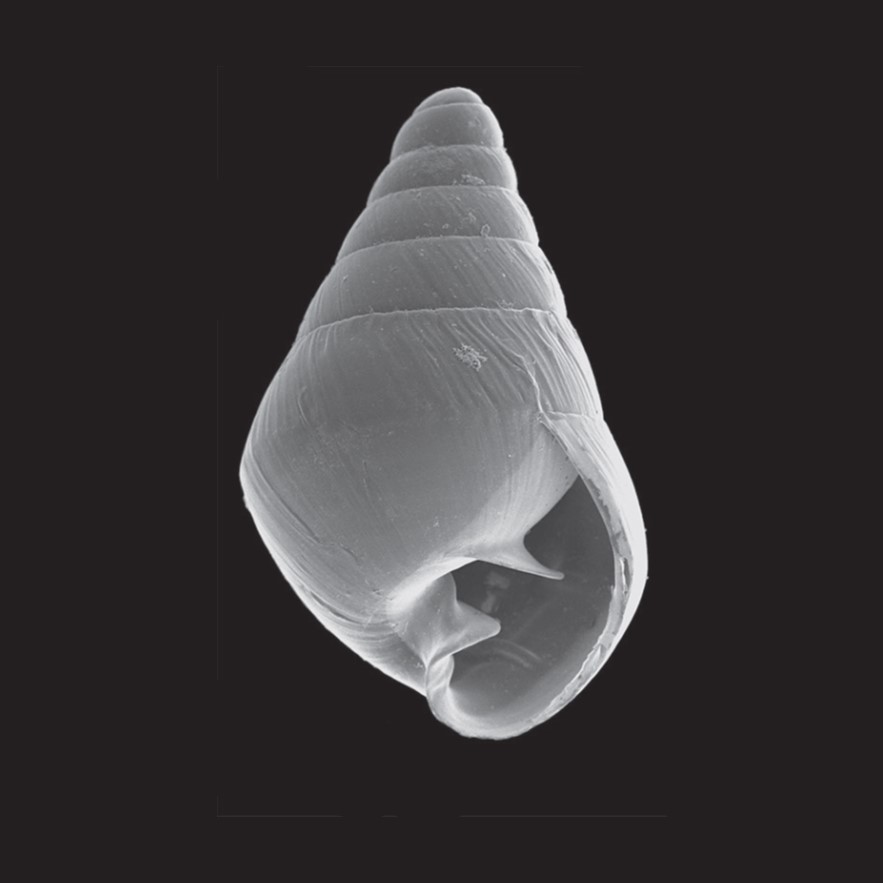
CLASSE: GASTROPODA: TERRESTRE
FAMÍLIA: ACHATINELLIDAE
ESPÉCIE: Tornatellina bilamellata (Anton, 1838)
Tamanho médio: 4.0 mm
Habitat: vive no solo, em serapilheira
Ocorrência: Chile (Arquipélago de Juan Fernandes, Ilha Robinson Crusoe (Masatierra))
Localidade tipo: Chile, ArquipélaGo de Juan Fernandez, Robinson Crusoe Island (Masatierra)
Nome original: Clausilia (Strobilus) bilamellata Anton, 1838
Sinônimos: Tornatellina clausa L. Pfeiffer, 1842
Descrição:
(Miquel & Araya, 2015): “Shell small, conic-ovate, very thin and glossy; corneous, with six to seven slightly flat whorls; the last whorl of about half the total length; protoconch with more than 2 whorls, ornamented with a very delicate irregular granulation; teleoconch sculptured only by prosocline growth wrinkles; suture slightly impressed, aperture elliptical, narrow, obstructed by a sharp sub-oblique lamella on the parietal wall, a strong transverse columellar fold and an incipient second columellar plica in the lower area of columellar wall; two delicate parallel palatal laminae; peristome acute; parietal wall glossy; outer lip simple, thin.”
Fotos: (1) Miquel & Araya, 2015: Tornatellina bilamellata (Anton 1839), MNHNCL 201790, “Juan Fernández Archipelago, Robinson Crusoe Island, El Yunque square”, 4.0 mm
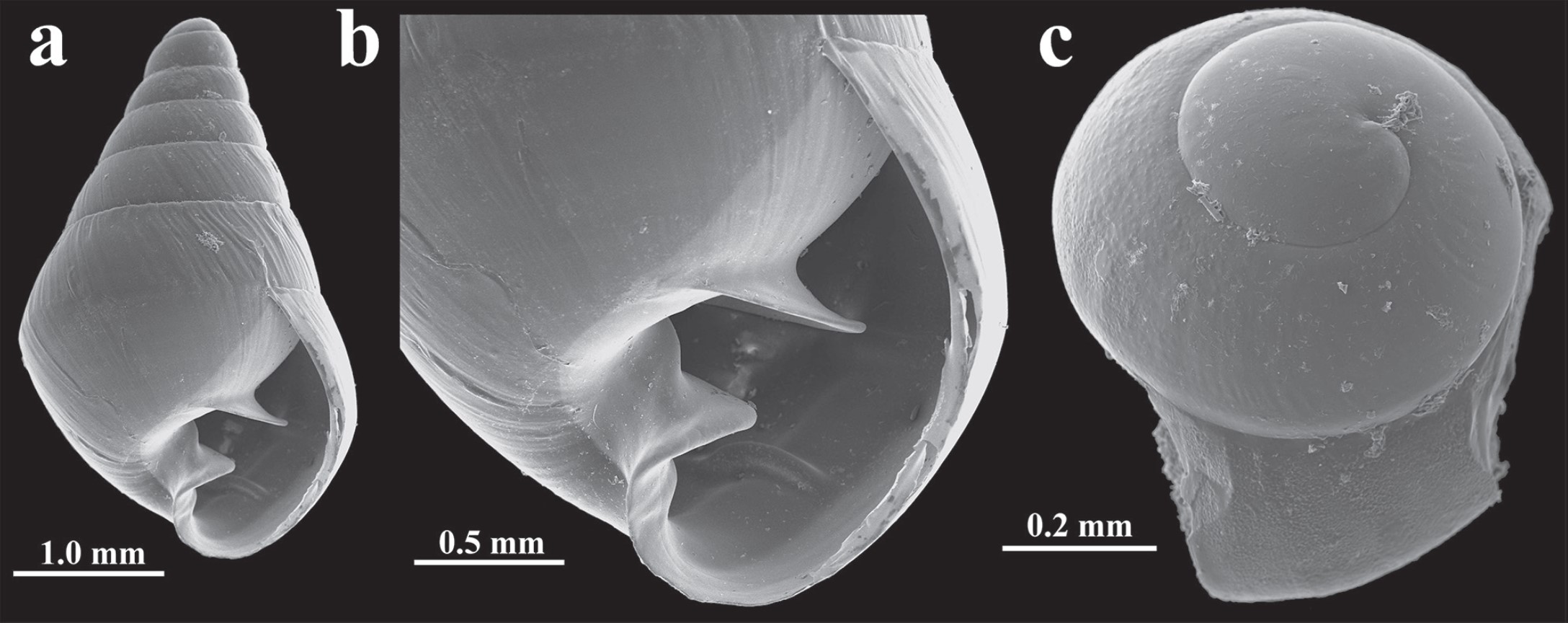
Figura: Miquel & Araya, 2015: Tornatellina bilamellata (Anton 1839). MNHNCL 201790: Juan Fernández Archipelago, Robinson Crusoe Island, El Yunque square: (a) vista da abertura ventral; (b) detalhe do dente, MNHNCL 201790, Juan Fernández Archipelago, Robinson Crusoe Island, “trail near Mirador Selkirk, west side”; (c) detalhe da protoconcha
Fontes:
Descrição original: (como Clausilia (Strobilus) bilamellata Anton, 1838) Anton, H. E. (1838). Verzeichniss der Conchylien welche sich in der Sammlung von Herrmann Eduard Anton befinden. Herausgegeben von dem Besitzer. Halle: Anton. xvi + 110 pp. [Title page dated 1839, but volume actually published in 1838; see Cernohorsky, 1978, The Veliger 20(3): 299]., disponível online em https://biodiversitylibrary.org/page/11967421
página(s): 46; note: as “Clausilia (Strobilus) bilamellatus“; wrong gender of species name
Letelier, Sergio & Báez, Pedro & Rebolledo, Andrea & Fabres, Alejandra. (2014). Moluscos terrestres nativos y exóticos del Archipiélago Juan Fernández (AJF) (Mollusca: Gastropoda). Boletín del Museo Nacional de Historia Natural de Chile. 63. 187-199
Miquel S.E. & Araya J.F. (2015). New records of terrestrial molluscs of the Juan Fernândez Archipelago (Chile), with the description of a new genus and species of Charopidae (Gastropoda: Stylommatophora). Archiv für Molluskenkunde. 144(2): 155-167., disponível online em https://doi.org/10.1127/arch.moll/1869-0963/144/155-167
Cooke, C. M. & Kondo, Y. (1961). Revision of Tornatellinidae and Achatinellidae (Gastropoda, Pulmonata). Bernice P. Bishop Museum Bulletin. 221: 1–303 [“1960”]., disponível online em http://hbs.bishopmuseum.org/pubs-online/pdf/bull221.pdf
Stuardo, José & Vega, René. (1985). Synopsis of the land mollusca of Chile. Studies on Neotropical Fauna and Environment. 20. 125-146
MolluscaBase: https://molluscabase.org/aphia.php?p=taxdetails&id=866742

Vive em árvores e arbustos

Vive sob ou sobre pedras

Vive em corais ou recifes

Vive em algas marinhas

Vivem em fundos de cascalho de coral, pedra ou conchas

Vive no solo. Sob folhas ou enterada parte do tempo

Vive em fundos arenosos, enterrada ou sob ele.

Animais que nadam ou vivem livremente

Presos a certos animais ou parasitando

Vive em fundos lodosos

Vive em plantas de água doce

Seu habitat é desconhecido

Alimenta-se de plantas e algas

Alimenta-se de outros animais

Alimenta-se de qualquer fonte

Alimenta-se de animais mortos
Seu hábito alimentar é desconhecido


