
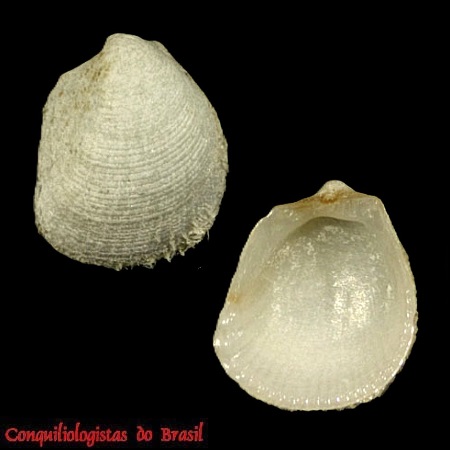
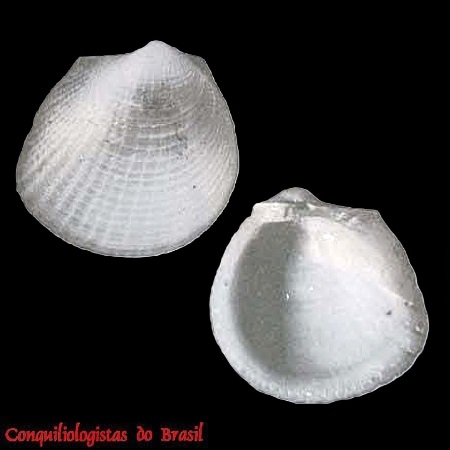
Habitat: substrato areno-lodoso, rico em matéria orgânica
Alimentação: filtrador
Frequência: rara
Ocorrência no Brasil: AP até CE
Localidade Tipo: off Havana, Cuba
Descrição original: Dall, W. H. (1881). Reports on the results of dredging, under the supervision of Alexander Agassiz, in the Gulf of Mexico and in the Caribbean Sea (1877-78), by the United States Coast Survey Steamer “Blake”, Lieutenant-Commander C.D. Sigsbee, U.S.N., and Commander J.R. Bartlett, U.S.N., commanding. XV. Preliminary report on the Mollusca. Bulletin of the Museum of Comparative Zoology at Harvard College. 9(2): 33-144., available online athttp://biodiversitylibrary.org/page/6353276page(s): p. 119-120
Referência: Forti Esteves, I. R. (1984). Recent bivalves (Palaeotaxodonta and Pteriomorphia) from the Brazilian continental shelf. Pesquisas [Porto Alegre]. 16: 190-226.
page(s): 197, pl. 5 figs 50-53..
Foto A: Bahamas. 4 mm. NMR – Museu de História Natural de Roterdam. Slieker F J A, van der Es H, Andeweg R, Langeveld B W, Schnörr S (2024). Natural History Museum Rotterdam – Specimens. Version 1.45. Natural History Museum Rotterdam. Occurrence dataset https://doi.org/10.15468/ kwqaay accessed via GBIF.org on 2025-07-11. https://gbif.org/occurrence/2570090040
Foto B:Norte do Brasil. 7 mm. Departamento de Paleontologia e Estratigrafia do Instituto de Geociencias da Universidade Federal do Rio Grande do Sul
Legenda
Árvore
Vive em árvores e arbustos
Pedra
Vive sob ou sobre pedras
Coral
Vive em corais ou recifes
Algas
Vive em algas marinhas
Cascalho
Vivem em fundos de cascalho de coral, pedra ou conchas
Terra
Vive no solo. Sob folhas ou enterada parte do tempo