
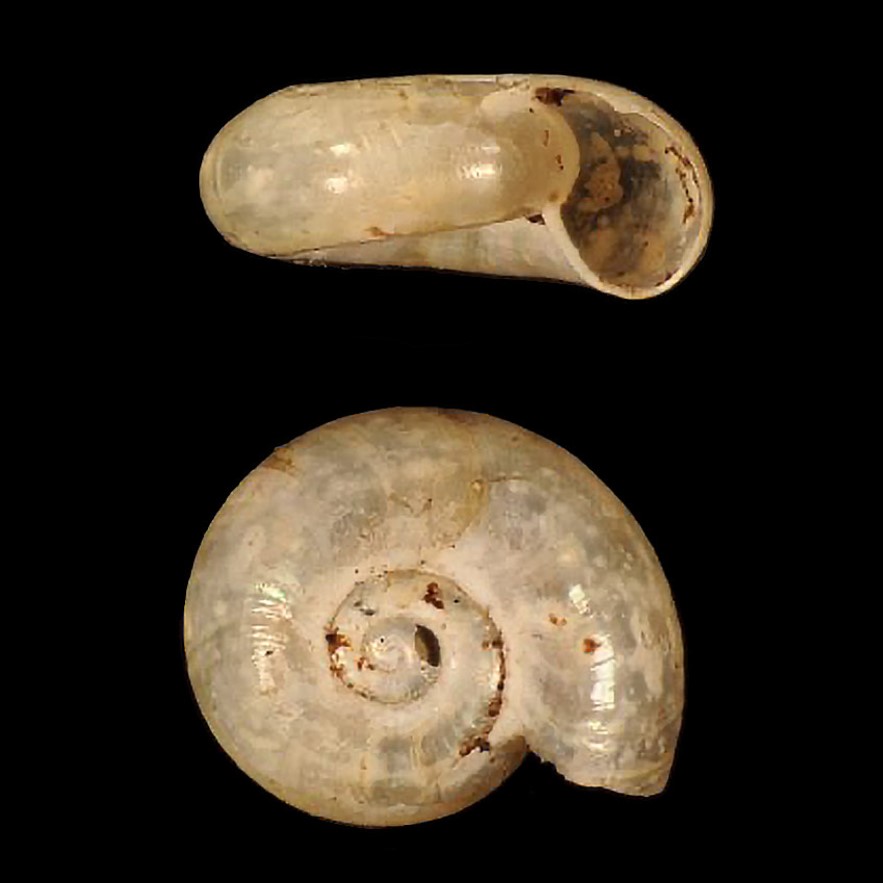
CLASSE: GASTROPODA: TERRESTRE
FAMÍLIA: SCOLODONTINAE
ESPÉCIE: Happia andia (Pilsbry, 1932)
Tamanho médio: 2.45 mm
Distribuição: Peru (Amazonas)
Localidade tipo: “Leymebamba, Department of Amazonas, Peru, at 7,000 ft” (Pilsbry 1932)
Nome original: Drepanostomella andia Pilsbry, 1932; Drepanostomella andium Pilsbry, 1932 [no original]
Redescrição:
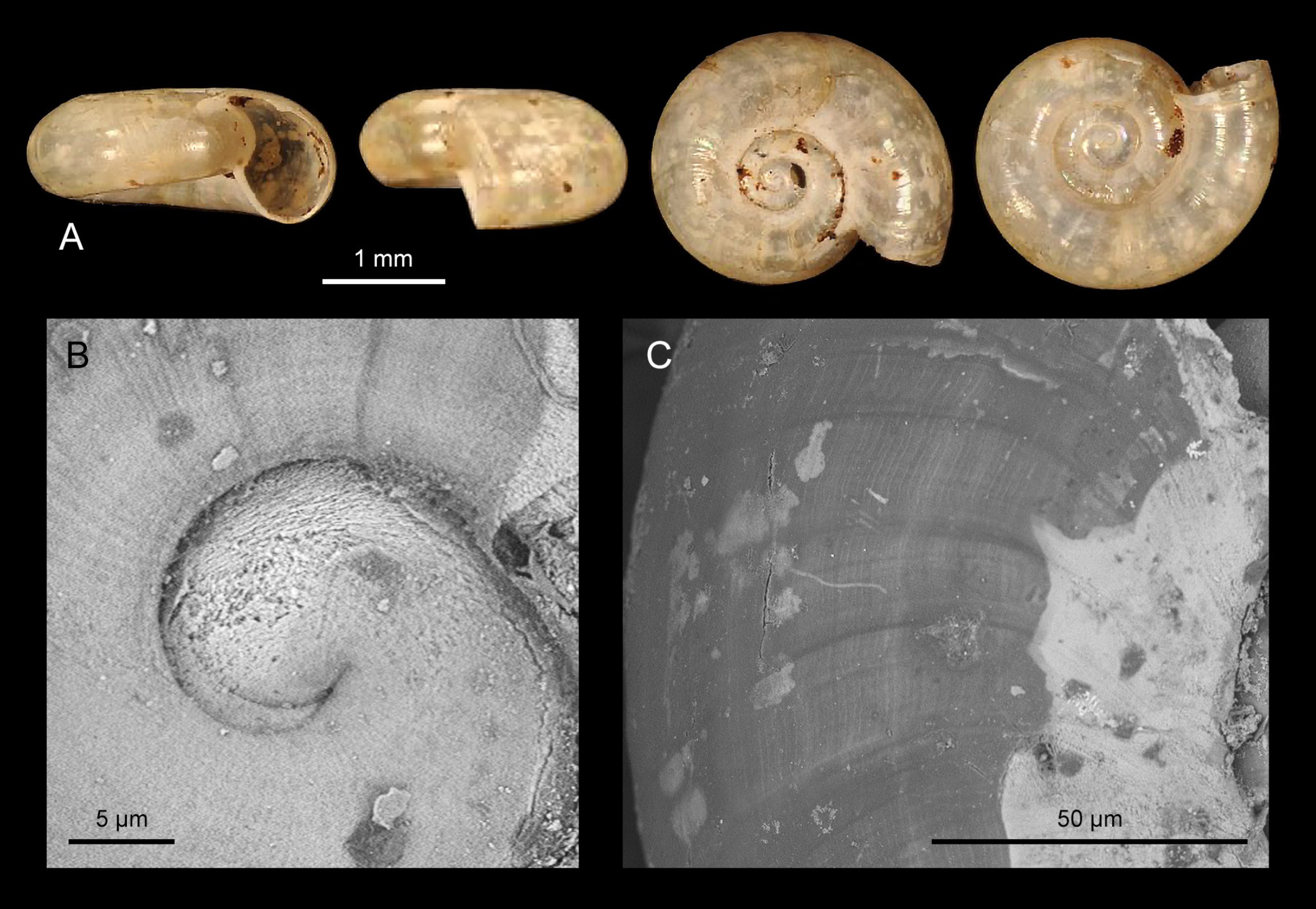
Roosen, M. T.; Salvador, R. B.; Breure, A. S. (2025): “Shell minute, transparent-whitish, with a slightly sunken spire. Protoconch 1¼ whorl, without sculpture. Teleoconch sculpture starts with a patch of 16 small, densely crowded axial ribs and numerous indistinct spiral
grooves. Spiral grooves cover entire teleoconch, but axial ribs become less crowded and distance between them more variable. Aperture ovate-drop-shaped, with thin, simple peristome. Umbilicus wide, up to 45% of shell width.“
Fotos: (1,2) Roosen, M. T. & Breure, A. S. H. (2024): The Academy of Natural Sciences, Philadelphia: HOLOTYPE de Happia andia (Pilsbry, 1932), ANSP 159924, collected by H. Radelyffe Roberts
Fontes:
Descrição original: (como Drepanostomella andia Pilsbry, 1932) Pilsbry, H. A. (1932). South American land and freshwater mollusks, 8. Collections of the Carriker-Roberts Peruvian expedition of 1932. Proceedings of the Academy of Natural Sciences of Philadelphia. 84: 387-402.
página(s): 400, text-figures 5, 5a-b
Roosen, M. T. & Breure, A. S. H. (2024). Revision of the genera of Scolodontidae, part 1: disentangling Happia Bourguignat, 1890 from Austroselenites Kobelt, 1905, Drepanostomella Bourguignat, 1890, Hirtudiscus Hylton Scott, 1973, Luteostriatella gen. nov., and Systrophiella H.B. Baker, 1925. Journal of Conchology. 45(1): 91-110., disponível online em https://doi.org/10.61733/jconch/4511
página(s): 93, 95, fig. 2
Rosenberg G (2026). Malacology Collection at the Academy of Natural Sciences of Philadelphia. Academy of Natural Sciences. Occurrence dataset https://doi.org/10.15468/xp1dhx accessed via GBIF.org on 2026-02-21. https://www.gbif.org/occurrence/4422593105
Molluscabase: https://molluscabase.org/aphia.php?p=taxdetails&id=1751264

Vive em árvores e arbustos

Vive sob ou sobre pedras

Vive em corais ou recifes

Vive em algas marinhas

Vivem em fundos de cascalho de coral, pedra ou conchas

Vive no solo. Sob folhas ou enterada parte do tempo

Vive em fundos arenosos, enterrada ou sob ele.

Animais que nadam ou vivem livremente

Presos a certos animais ou parasitando

Vive em fundos lodosos

Vive em plantas de água doce

Seu habitat é desconhecido

Alimenta-se de plantas e algas

Alimenta-se de outros animais

Alimenta-se de qualquer fonte

Alimenta-se de animais mortos
Seu hábito alimentar é desconhecido


