
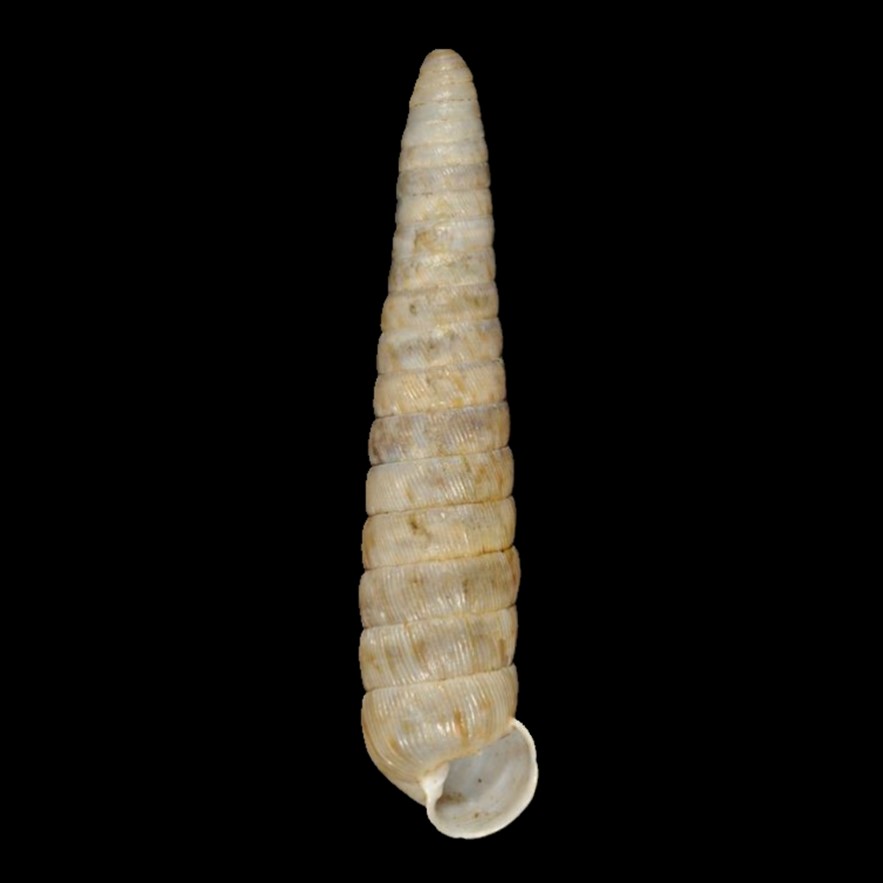


CLASSE: GASTROPODA: TERRESTRE
FAMÍLIA: MEGASPIRIDAE
ESPÉCIE: Megaspira pilsbryi Rehder, 1945
Tamanho médio: 35 – 40 mm
Habitat: Mata Atlântica
Ocorrência: Brasil (Rio de Janeiro)
Localidade tipo: Rio de Janeiro
Nome original: Megaspira pilsbryi Rehder, 1945
Etimologia: o nome da espécie é uma homenagem a Henry Augustus Pilsbry (Iowa 1862 – Flórida 1957). Pilsbry foi um biólogo, malacólogo e carcinólogo. Notabilizou-se mundialmente pelo seu estudo dos moluscos (Mollusca), em particular dos Polyplacophora e dos gastrópodes terrestres
Descrição original:
(Rehder, 1945): “A Note on Megaspira elata Gould.* — On critically examining the type of Megaspira elata Gould 1847 (U.S.N.M. 5503), collected in Brazil by the United States Exploring Expedition, I discovered that it is Megaspira elatior Spix 1827, agreeing with it in sculpture and in the internal armature. The species described as Megaspira elata Gould by Pilsbry (Man. Conch, (ser. 2), vol. 16, p. 186, pi. 28, figs. 5, 6; pi. 29, figs. 12, 13, 1904) differs in having more crowded, less retractively inclined ribs and in having the radial basal lamellae lower and without hooks. This species may be called Megaspira pilsbryi, new name ( = M. elata (Gould) Pilsbry 1904, not Gould 1847).
It is apparently a rarer shell than Megaspira elatior. In the collections of the U. S. National Museum there is only one specimen of pilsbryi, and 6 of elatior; I have also seen the two specimens of pilsbryi from the collections of The Academy of Natural Sciences of Philadelphia (Cat. Nos. 3057 and 25041), which are figured on plate 28 of the Manual.
It may be noted that the species figured by Gould as Megaspira elatior Spix (U. S. Explor. Exped., vol. 12, Moll, and Shells, pi. 7, fig. 102, 1852) (U.S.N.M. No. 5504), and the other specimens so labeled and also collected by the Exploring Expedition (U.S.N.M. No. 22073), are all Megaspira ruschenbergiana ‘Lea’ Jay. — 11. A.”
Fotos: (1-3) The Academy of Natural Sciences, Philadelphia: LECTOTYPE ANSP 25041, Brasil, Swift Collection; (4) cortesia Femorale, 2024, Rio de Janeiro, 38.2mm

Figura: Daniel, V. R.; Ovando, X. M.; Santos, S. B. (2022): (5-6) LECTOTYPE de Megaspira pilsbryi (ANSP 25041); (7–9) LECTOTYPE de Megaspira iheringi (ANSP 100532); (10–12) LECTOTYPE de Megaspira elatior robusta (ANSP 71925)
Fontes:
Descrição original: Rehder, H. A. (1945). A note on Megaspira elata Gould. The Nautilus. 59(2): 67., disponível online em https://www.biodiversitylibrary.org/page/8523564
Simone, L. R. L. (2006). Land and Freshwater Molluscs of Brazil. Editora Gráfica Bernardi, FAPESP. São Paulo, 390 pp. página(s): 182
H. B. Baker, 1963. Proceedings of the Academy of Natural Sciences of Philadelphia 115 (8): 207
Pilsbry, H. A. (1903-1904). Manual of conchology, structural and systematic, with illustrations of the species. Ser. 2, Pulmonata. Vol. 16: Urocoptidae, Achatinidae. pp i-xl, 1-329, pls 1-37. Philadelphia, published by the Conchological Department, Academy of Natural Sciences. [pp. 1-64, pls 1-18, 6 October 1903; 65-128, pls 19-31, 28 November 1903; 129-192, pls 1-15, 8 January 1904; i-xl, 193-329, pls 16-37, 7 March 1904.]. , disponível online em https://www.biodiversitylibrary.org/page/1104120
página(s): 186, pl. 28 figs 5-6, pl. 29 figs 12-13 ; Comentário: como Megaspira elata [erro de identificação]
Daniel, V. R.; Ovando, X. M.; Santos, S. B. (2022). A new species of Megaspira (Stylommatophora: Megaspiridae) from Ilha Grande, Southeast Brazil. Zoologia (Curitiba). 39: e21022., disponível online em https://doi.org/10.1590/s1984-4689.v39.e21022
página(s): 5, figs 5-6
MolluscaBase: https://www.molluscabase.org/aphia.php?p=taxdetails&id=1448193

Vive em árvores e arbustos

Vive sob ou sobre pedras

Vive em corais ou recifes

Vive em algas marinhas

Vivem em fundos de cascalho de coral, pedra ou conchas

Vive no solo. Sob folhas ou enterada parte do tempo

Vive em fundos arenosos, enterrada ou sob ele.

Animais que nadam ou vivem livremente

Presos a certos animais ou parasitando

Vive em fundos lodosos

Vive em plantas de água doce

Seu habitat é desconhecido

Alimenta-se de plantas e algas

Alimenta-se de outros animais

Alimenta-se de qualquer fonte

Alimenta-se de animais mortos
Seu hábito alimentar é desconhecido


