

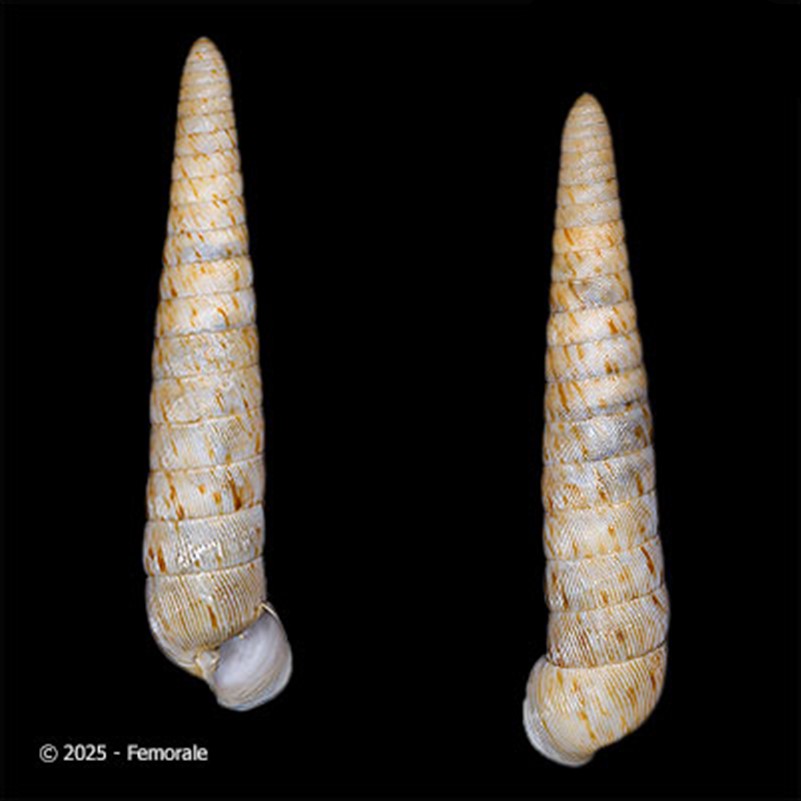
CLASSE: GASTROPODA: TERRESTRE
FAMÍLIA: MEGASPIRIDAE
ESPÉCIE: Megaspira ruschenbergiana I. Lea, 1836
Tamanho médio: 63 – 73 mm
Habitat: vive no solo, na serapilheira, na Mata Atlântica
Frequência: Raro, conhecido apenas por antigos exemplares de coleção
Ocorrência: Brasil (Rio de Janeiro, Minas Gerais)
Localidade tipo: Brasil, ‘‘cum praecedentibus [in Provinciis mediis orientalibus]’’
Nome original: Megaspira ruschenbergiana I. Lea, 1836
Etimologia: o nome da espécie é uma homenagem a William Samuel Waithman Ruschenberger (1807–1895). Ruschenberger foi cirurgião da Marinha norte americana, naturalista, presidente da Academy of Natural Sciences of Philadelphia (ANSP) de 1870 até 1882
Comentários:
(1) Simone, 2006 e Molluscabase (2025) consideram como sinônimo de Megaspira elatior
(2) Segundo Daniel, Ovando & Santos, 2022: Simone, 2006 não forneceu uma justificativa para sinonimizar Megaspira ruschenbergiana, dessa forma, mantivemos as duas espécies aqui para comparação
Redescrição:
(Pilsbry, 1904): “Shell openly rimate-perforate, cylindric-tapering, rather solid; yellowish, variegated with red-brown streaks and spots. Sculpture of oblique rounded riblets as wide as their intervals, the latter more or less wrinkled across; about 3 riblets in the space of 1 mm.; 3 apical whorls very finely striate, usually worn in adult shells. Whorls 22 to 24, slightly convex. Aperture slightly oblique, irregularly ovate. Peristome thin, expanded, the columellar margin dilated and reflexed above, notched at, and a short distance below, the insertion.
Columella convex, bearing three entering lamellae. Parietal wall with a strong entering lamella. Axis perforate but slender throughout. Columellar lamella wide and scalloped in 3 whorls preceding the last whorl, the scallops bent downwards; in the last whorl and the median and upper whorls it is reduced to a smooth, rather small lamella. The sub columellar lamella penetrates inward as far as the enlarged portion of the columellar, running on the lower side of the latter.
The supracolumellar lamella penetrates as a low cord about two whorls. Baso-axial radial barriers begin in the fourth whorl from the last; are high, curved, with the upper edge bent forward, and hooked at the axial end. The next to the last barrier, in the back of the penult, whorl, is continued in a spiral thread, running on the floor of the cavity of the first half of the last whorl (fig. 2, pl).
Length 62, diam. above aperture 11 mm., whorls 23 1/3. Length 59, diam. above aperture 10.6 mm., whorls 22 2/3. Length 54.5, diam. above aperture 10.3 mm., whorls 22. Brazil: Prov. Minas Geraes (Fontaine).”
Fotos: (1) cortesia Guido & Philippe Poppe, 2015, 62.5 mm; (2) cortesia Femorale, 2025, 58.2 mm; (3) Conchas e etiquetas de Megaspira elatior, NCB Naturalis, Leiden, ZMA.MOLL.32733; (4) Conchas e etiquetas de Megaspira ruschenbergiana, NCB Naturalis, Leiden, ZMA.MOLL 270931


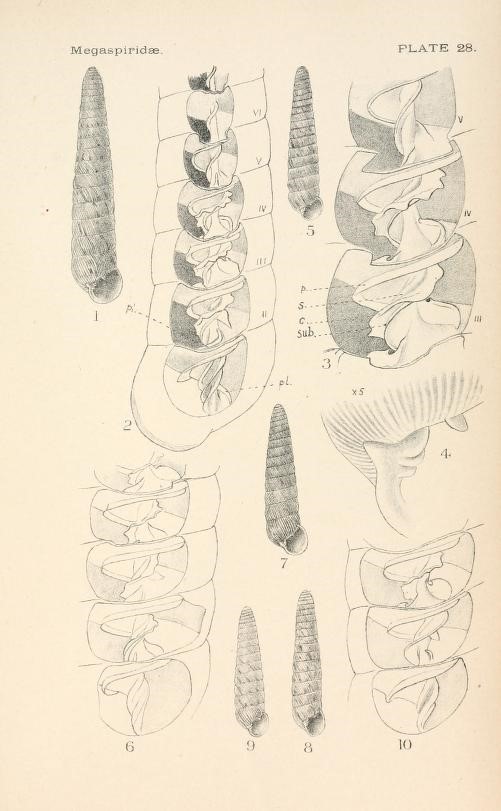
Figura: Pilsbry, 1904: (1,5,7,8,9) desenhos por Helen Winchester; demais por H. A. Pilsbry; (1-4) Megaspira ruschenbergiana Lea 182; (5,6) Megaspira elata (Gould 1847); (7) Megaspira elatior robusta Pilsbry, 1904; (8) Megaspira elatior gracilis Pilsbry, 1904; (9-10) Megaspira elatior (Spix, 1827)
Fontes:
Descrição original: (como Megaspira ruschenbergiana I. Lea, 1836) Jay J.C. (1836). A catalogue of recent shells with description of new or rare species in the collection of John C. Jay. 2nd edition. New York. 77 pp., errata, 4 pls. , disponível online em https://www.biodiversitylibrary.org/page/12172590
página(s): explanação na pl. 1
Pilsbry, H. A. (1903-1904). Manual of conchology, structural and systematic, with illustrations of the species. Ser. 2, Pulmonata. Vol. 16: Urocoptidae, Achatinidae. pp i-xl, 1-329, pls 1-37. Philadelphia, published by the Conchological Department, Academy of Natural Sciences. [pp. 1-64, pls 1-18, 6 October 1903; 65-128, pls 19-31, 28 November 1903; 129-192, pls 1-15, 8 January 1904; i-xl, 193-329, pls 16-37, 7 March 1904.]., disponível online em https://www.biodiversitylibrary.org/page/1104120
página(s): 184, pl. 28 figs 9-10
Abbott, R. T. (1955). The Titian R. Peale Shell Collection. The Nautilus. 68(4): 123-127, pl. 4, figs. 1-6., disponível online em https://www.biodiversitylibrary.org/page/8516606
página(s): 125, pl. 4, fig. 5; nota: Atribuído a I. Lea
Simone, L. R. L. (2006). Land and Freshwater Molluscs of Brazil. Editora Gráfica Bernardi, FAPESP. São Paulo, 390 pp. página(s): 182
Daniel, V. R.; Ovando, X. M.; Santos, S. B. (2022). A new species of Megaspira (Stylommatophora: Megaspiridae) from Ilha Grande, Southeast Brazil. Zoologia (Curitiba). 39: e21022., disponível online em https://doi.org/10.1590/s1984-4689.v39.e21022
páginas(s): 4, figs 13-35
MolluscaBase: https://molluscabase.org/aphia.php?p=taxdetails&id=1389066

Vive em árvores e arbustos

Vive sob ou sobre pedras

Vive em corais ou recifes

Vive em algas marinhas

Vivem em fundos de cascalho de coral, pedra ou conchas

Vive no solo. Sob folhas ou enterada parte do tempo

Vive em fundos arenosos, enterrada ou sob ele.

Animais que nadam ou vivem livremente

Presos a certos animais ou parasitando

Vive em fundos lodosos

Vive em plantas de água doce

Seu habitat é desconhecido

Alimenta-se de plantas e algas

Alimenta-se de outros animais

Alimenta-se de qualquer fonte

Alimenta-se de animais mortos
Seu hábito alimentar é desconhecido


