


CLASSE: GASTROPODA: TERRESTRE
FAMÍLIA: BOTHRIEMBRYONTIDAE
ESPÉCIE: Plectostylus mariae Brooks, 1936
Tamanho médio: 30 mm
Ocorrência: Chile (Neuquén), Argentina (Chubut, Río Negro)
Habitat: Brooks (1936) relatou que foi encontrado em árvores em San Esteban, Chile. De acordo com Hylton Scott (1963), vive nas margens arborizadas que margeiam lagos do sul da Argentina e do Chile (Miquel,2010)
Localidade tipo: Chile, San Esteban [HOLOTYPE Carnegie Museum 6228184]
Nome original: Plectostylus mariae Brooks, 1936
Sinônimos: Plectostylus argentinensis Parodiz, 1951
Etimologia: o nome da espécie é uma homenagem à senhora W. L. (Mary) Mellon. Durante o inverno e início da primavera de 1936, o Yacht “Vagabondia” pertencente a W. L. Mellon de Pittsburgh (EUA) cruzou as águas do Caribe, atravessou o Canal do Panamá e foi em direção ao Pacífico Sul até a Tierra del Fuego e o Estreito de Magalhães
Descrição original:
(Brooks, 1936): “Shell imperforate, thin, ovate, yellowish corneous with oblique, longitudinal streaks of dark yellow and brown; on the upper whorls irregular, vertical arcs of dark brown appear, the last occurring half way down the body whorl (as in Plectostylus reflexus Pfeiffer) ; surface smooth, shining, under the lens it appears granulated by very indistinct spiral lines; spire short, pointed; whorls five, quite convex; aperture long-ovate 19.6 mm. in altitude and 8.3 mm. in diameter, bluish white within, peristome thin sharp, with brownish border; columella granular, rounded and thin.”
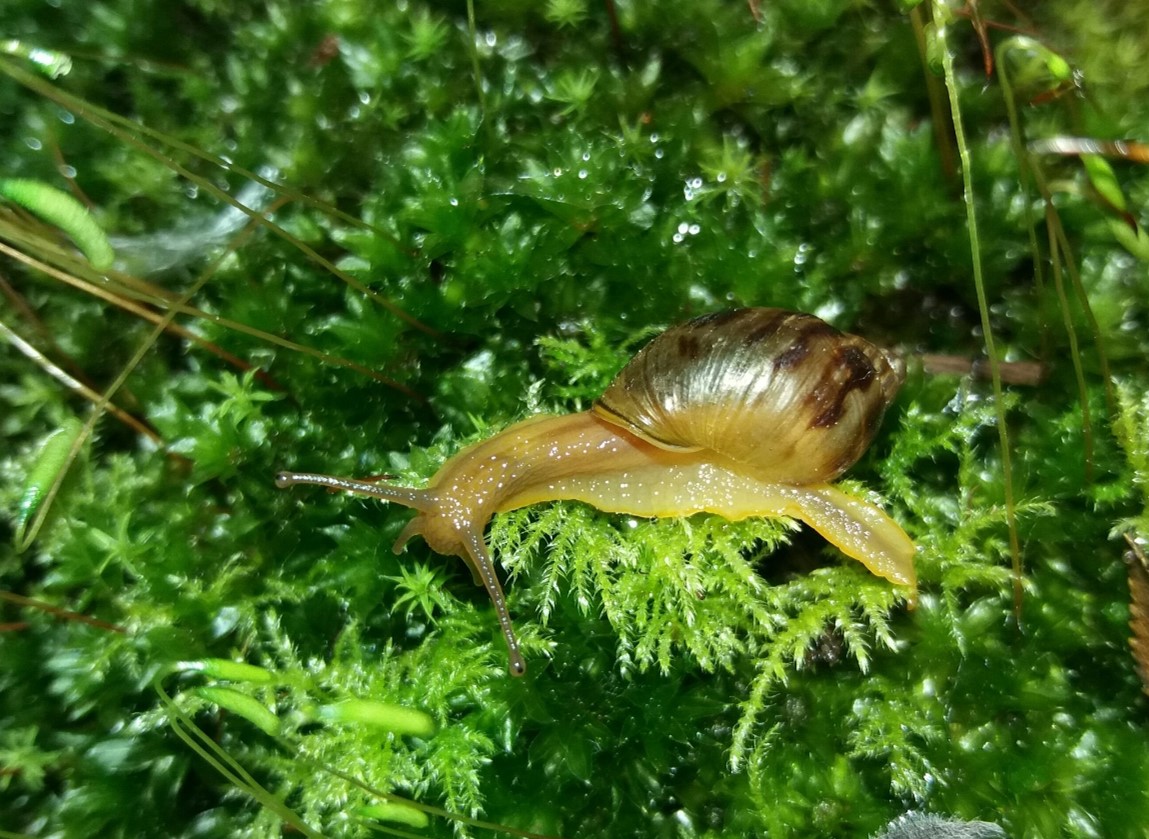
Fotos: (1,2) Montenegro, R., D. Forcelli, E. Salas Oroño, S. Miquel, 2024: Museo Argentino de Ciencias Naturales “Bernardino Rivadavia”, Colección de Invertebrados Buenos Aires: Plectostylus mariae Brooks, 1936: (1) MACN-In 6514, Argentina, Província de Neuquén, San Martín de los Andes; (2) MACN-In 32845, Argentina, Lago Lacar, Neuquén; (3) animal vivo: observação iNaturalist 168585119, Chile, Província Osorno, Los Lagos, crédito: Daniel Stange
Fontes:
Descrição original: Brooks, S. T. (1936). The land snails collected during the 1936 voyage of the “Vagabondia” with descriptions of new species of Plectostylus. Annals of the Carnegie Museum. 25: 123-126., disponível online em https://www.biodiversitylibrary.org/page/52377339
página(s): 124
Descrição original: (como Plectostylus argentinensis Parodiz, 1951) Parodiz, J. J. (1951). Una nueva especie de “Plectostylus” (Gastr. Pulm.) de la Argentina. Physis. 20(58): 334–335
Cuezzo, M. G., Jose Miranda, M. & Ovando, X. M. C. (2013). Species Catalogue of Orthalicoidea in Argentina (Gastropoda: Stylommatophora). Malacologia. 56(1 & 2): 135-191., disponível online em https://doi.org/10.4002/040.056.0210
página(s): 141
Valdovinos, C. & Stuardo, J. R. (1988). Morfología, sistemática y distribución del género Plectostylus Beck 1837 (Pulmonata: Bulimulidae). Gayana, Zoologia. 52(1-2): 115–195., disponível online em https://www.biodiversitylibrary.org/page/28128676
página(s): 130
Miquel, Sergio. (2010). Redescription of Argentinean Species of the Genera Discoleus, Plectostylus, Scutalus and Simpulopsis (Gastropoda, Stylommatophora, Bulimulidae). Studies on Neotropical Fauna and Environment. December 1998. página(s) 178-187
Montenegro, R., D. Forcelli, E. Salas Oroño, S. Miquel, 2024. Iconografía de Moluscos Continentales de Argentina – Primera parte. Fundación de Historia Natural Félix de Azara. Libro digital
Molluscabase: https://molluscabase.org/aphia.php?p=taxdetails&id=1288547

Vive em árvores e arbustos

Vive sob ou sobre pedras

Vive em corais ou recifes

Vive em algas marinhas

Vivem em fundos de cascalho de coral, pedra ou conchas

Vive no solo. Sob folhas ou enterada parte do tempo

Vive em fundos arenosos, enterrada ou sob ele.

Animais que nadam ou vivem livremente

Presos a certos animais ou parasitando

Vive em fundos lodosos

Vive em plantas de água doce

Seu habitat é desconhecido

Alimenta-se de plantas e algas

Alimenta-se de outros animais

Alimenta-se de qualquer fonte

Alimenta-se de animais mortos
Seu hábito alimentar é desconhecido


