

CLASSE: GASTROPODA: TERRESTRE
FAMÍLIA: SCOLODONTIDAE
ESPÉCIE: Xenodiscula venezuelensis Pilsbry, 1919
Tamanho médio: 1.5 mm
Distribuição: Colômbia, Peru (Paguana), Venezuela (Cariaquita)
Localidade tipo: Venezuela, Cariaquita, leg. Brown (14.iii.1911)
Nome original: Xenodiscula venezuelensis Pilsbry, 1919
Descrição original:
(Roosen, M., Weijsenfeld, J. & Dorado, C., 2023): “Shell, whitish transparent, small, discoid, with a sunken spire. Early whorls partially covered by succeeding whorls. Embryonic shell ca. ½ whorl, without sculpture. Teleoconch sculpture con-sists of minute growth lines and irregularly spaced, slightly flexuous axial grooves which are more crowded on the oldest whorls. On the first ½ whorl of the teleoconch up to 19 grooves are present, while on younger whorls this number is reduced to 16 grooves per ½ whorl.
Numerous weaker grooves are present in the spaces between grooves, aside from the shell’s growth lines. Whorl profile weakly convex, aperture broadly lunulate, peristome simple. Four lamellae are present on the parietal wall. The highest lamella is the third, which is three times as high as the fourth lamella. The upper two parietal lamellae are reduced to small ridges, while the fourth is well developed. One palatal lamella present, shaped like a rounded bulge. Last, two denticle like lamella can be seen at the base of the aperture. Umbilicus wide, up to 39.7% of total width”
Fotos: (1) Roosen, M., Weijsenfeld, J. & Dorado, C. (2023)
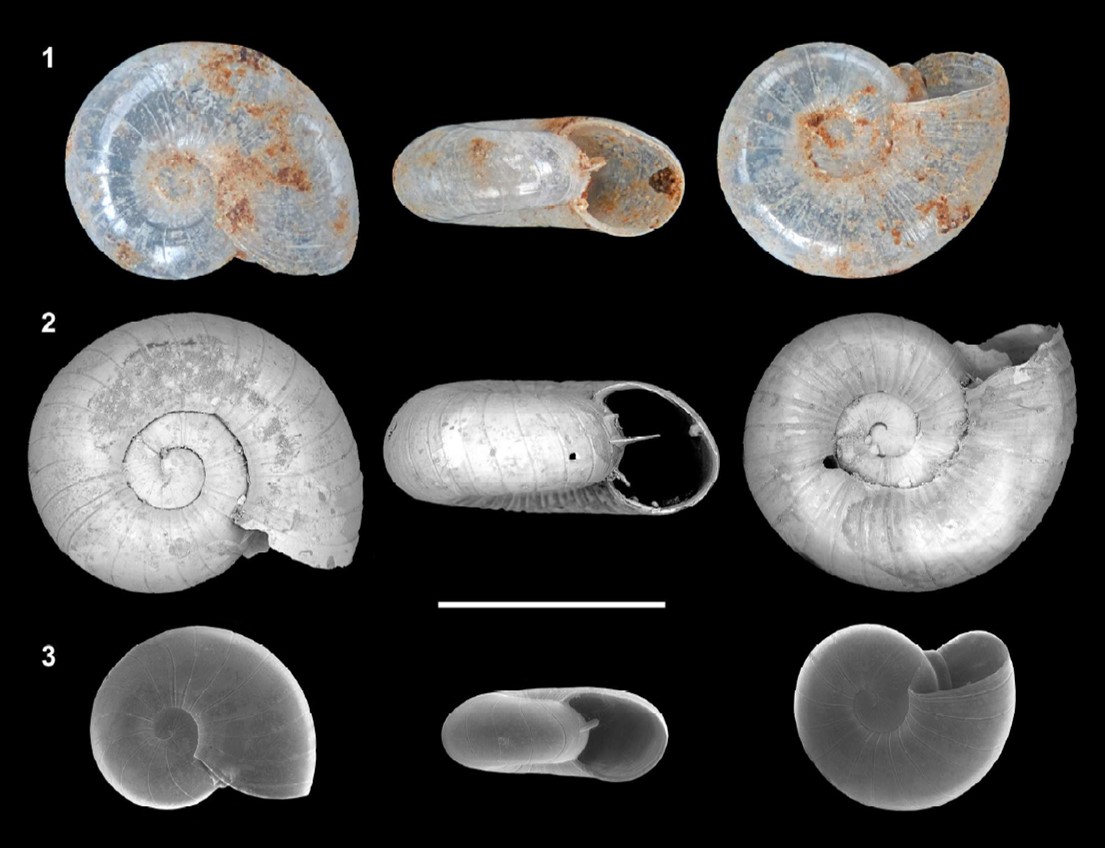
Figura: Roosen, M., Weijsenfeld, J. & Dorado, C. (2023): (1) Xenodiscula taintori Goodrich et Van der Schalie, 1937 (PARATYPE, ANSP 177259), Guatemala, Petén, “Limestone outcrops 1 mile north-west of Paso Caballo”; (2) Xenodiscula venezuelensis Pilsbry, 1919 (SYNTYPE, ANSP 105209), Venezuela, Cariaquita, leg. Brown (14.iii.1911); (3) Xenodiscula yumbo, HOLOTYPE INABIOEC-MCL-1214, Equador, Pichincha, “Un Poco del Chocó nature reserve, near Las Tolas (Gualea)”, leg. M. T. Roosen 2019
Fontes:
Descrição original: Pilsbry, H. A. (1919). A peculiar Venezuelan land snail. Proceedings of the Academy of Natural Sciences of Philadelphia. 71: 206., disponível online em https://www.biodiversitylibrary.org/page/1970836
Baker, H. B. (1926). The Mollusca collected by the University of Michigan-Williamson Expedition in Venezuela. Part IV. Occasional Papers of the Museum of Zoology, University of Michigan. 167: 1-65.
página(s): 16
Thompson, F. G. (1957). A collection of mollusks from northern Venezuela. Occasional Papers of the Museum of Zoology University of Michigan. 591: 1-10, 4 figs, 2 pls.
página(s): 8
Roosen, M., Weijsenfeld, J. & Dorado, C. (2023). Notes on the genus Xenodiscula Pilsbry, 1919 (Gastropoda: Scolodontidae), with the description of a new species from NW Ecuador. Folia Malacologica. 31(2): 100–106., disponível online em https://www.foliamalacologica.com/Notes-on-the-genus-Xenodiscula-Pilsbry-1919-Gastropoda-Scolodontidae-with-the-description,166314,0,2.html
página(s): 103, Figs 2, 8
Roosen, M. T. & Breure, A. S. H. (2024). Revision of the genera of Scolodontidae, part 2: Guestieria Crosse, 1872, Xenodiscula Pilsbry, 1919, and a misidentified planorbid. Journal of Conchology. 45(2): 245-250, figs. 1-2 [6 Oct.].
página(s): 247-248, fig. 2C
Molluscabase: https://molluscabase.org/aphia.php?p=taxdetails&id=1453756

Vive em árvores e arbustos

Vive sob ou sobre pedras

Vive em corais ou recifes

Vive em algas marinhas

Vivem em fundos de cascalho de coral, pedra ou conchas

Vive no solo. Sob folhas ou enterada parte do tempo

Vive em fundos arenosos, enterrada ou sob ele.

Animais que nadam ou vivem livremente

Presos a certos animais ou parasitando

Vive em fundos lodosos

Vive em plantas de água doce

Seu habitat é desconhecido

Alimenta-se de plantas e algas

Alimenta-se de outros animais

Alimenta-se de qualquer fonte

Alimenta-se de animais mortos
Seu hábito alimentar é desconhecido


