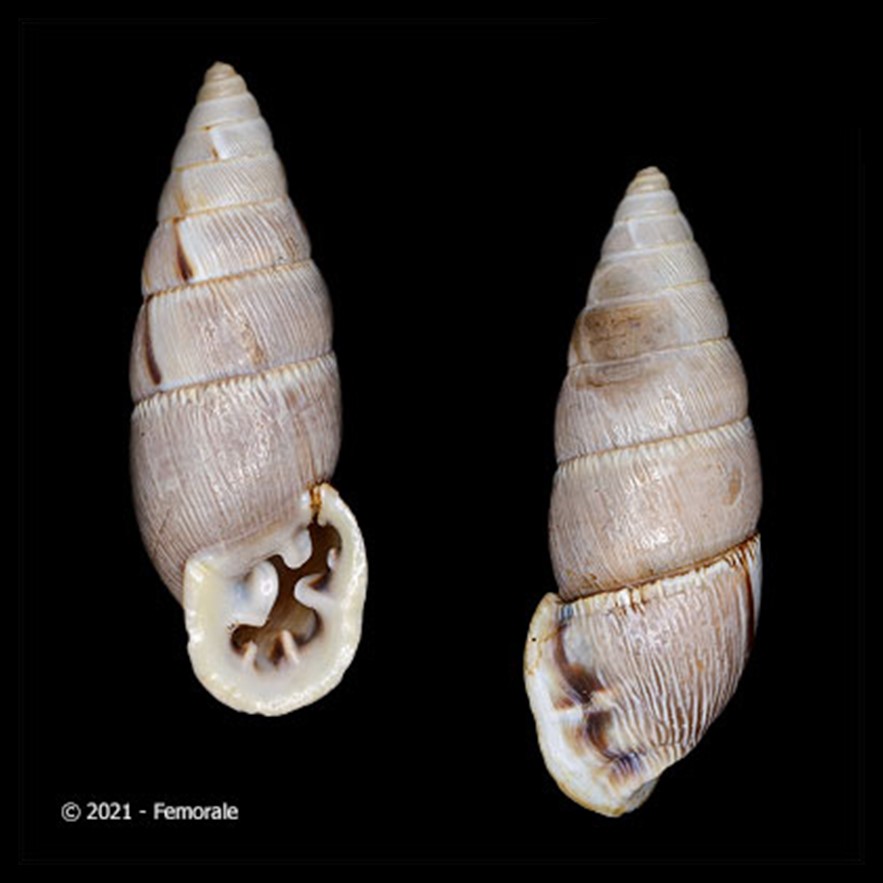
CLASSE: GASTROPODA: TERRESTRE
FAMÍLIA: CYCLODONTINIDAE
ESPÉCIE: Cyclodontina branneri (Dall, 1909)
Tamanho médio: 30 mm
Ocorrência: Brasil (Bahia)
Localidade tipo: Brasil, Bahia, Serra do Mulato, próximo ao Rio São Francisco
Nome original: Odontostomus (Cyclodontina) branneri Dall, 1909
Sinônimos: Odontostomus branneri Dall, 1909
Etimologia: o nome da espécie Cyclodontina branneri é uma homenagem ao geólogo norte americano e especialista em geologia brasileira, John Casper Branner (1850-1922). Enquanto esteve em Stanford, dirigiu a expedição Louis Agassiz-Branner ao Brasil em 1899 e uma segunda expedição semelhante em 1907-1908. Em 1911, Branner liderou uma expedição ao Brasil chamada de Stanford Expedition to Brazil para tratar especificamente de uma problemática evolutiva, que procurava evidências do lugar que ocuparia o isolamento geográfico no processo de seleção natural
Descrição original:
(Dall, 1909): “Shell slender, elongate, subacute, with nine and a half whorls separated by a narrow, deep, but not channeled suture; nucleus small, minutely punctate, with an apical dimple; the subsequent sculpture of fine, even, closeset retractive wrinkles, or riblets, extending from suture to suture and over the base; color white, with irregularly disposed brown lines, usually distant and in harmony with the sculpture; whorls very slightly rounded, the last finally attenuated and externally impressed over the internal denticles; under the reflected lip and behind the large lamina on the pillar is a minute umbilical chink.
Aperture with a strongly reflected white peristome, with a thin layer of parietal callus, separated from the lip at either end by a channel, shallow at the pillar-lip but deep at the external angle, where it is bounded in front by a small lamina this sulcus, however, is not indicated externally (as in O. sectilabris) by a marginating band in front of the suture; the armature of the aperture externally visible resembles that of O. sectilabris Pfeiffer, but, in harmony with the whole aperture, is narrower, and the left hand basal tooth of scctilabris is represented by two small but quite separate teeth; an examination of the internal armature shows that half a whorl behind the large pillar-tooth the margin of the pillar is gyrate and swollen, forming a lumpy callosity in the first half of the last whorl ; in O. sectilabris, however, the same part of the axis is slender, not gyrate or swollen, but merely twisted like the axis in the whorls above.”
Comentários: HOLOTYPE USNM 205956
Fotos: (1,2) cortesia Femorale, 2021, Bahia, 26mm
Fontes:
Descrição original: (como Odontostomus branneri Dall, 1909) Dall, W. H. (1909). Some new South American land shells. Smithsonian Miscellaneous Collections. 52 (3): 361-364., disponível online em https://www.biodiversitylibrary.org/page/8812815
página(s): 363, pl. 37, figs 2-4
Simone, L. R. L. (2006). Land and Freshwater Molluscs of Brazil. Editora Gráfica Bernardi, FAPESP. São Paulo, 390 pp. página(s): p.164, fig. 566
Wikipedia (2024): https://www.wikiwand.com/pt/John_Casper_Branner
Molluscabase (2024): https://www.molluscabase.org/aphia.php?p=taxdetails&id=1448058