
CLASSE: GASTROPODA: ÁGUA DOCE
FAMÍLIA: PLANORBIDAE
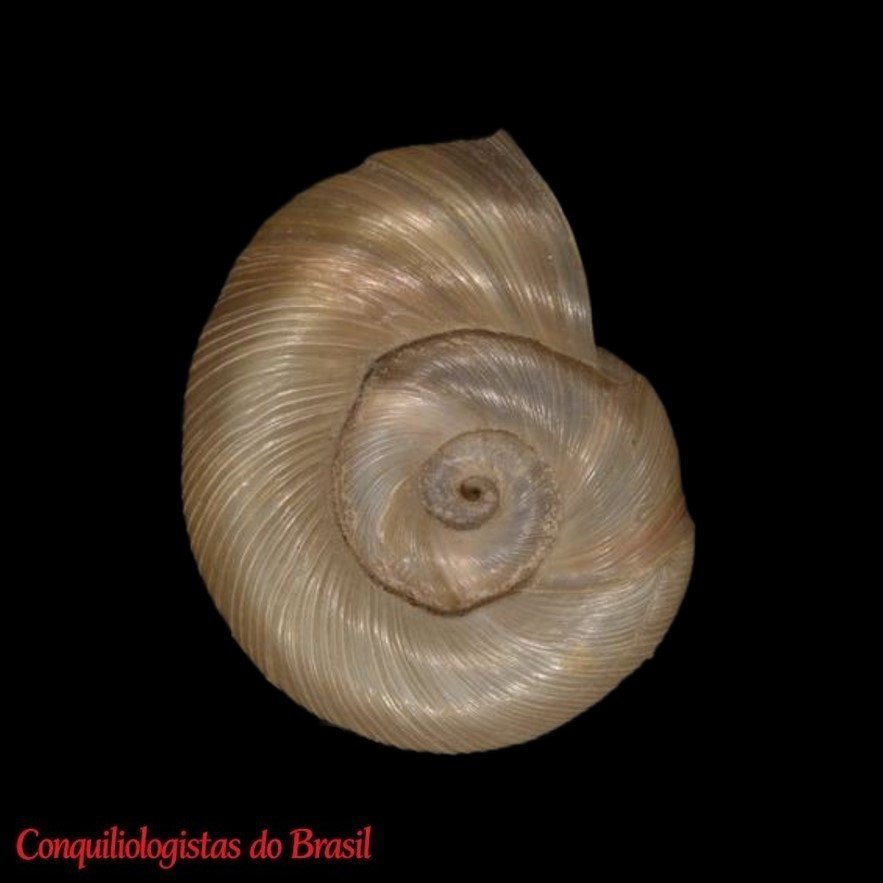
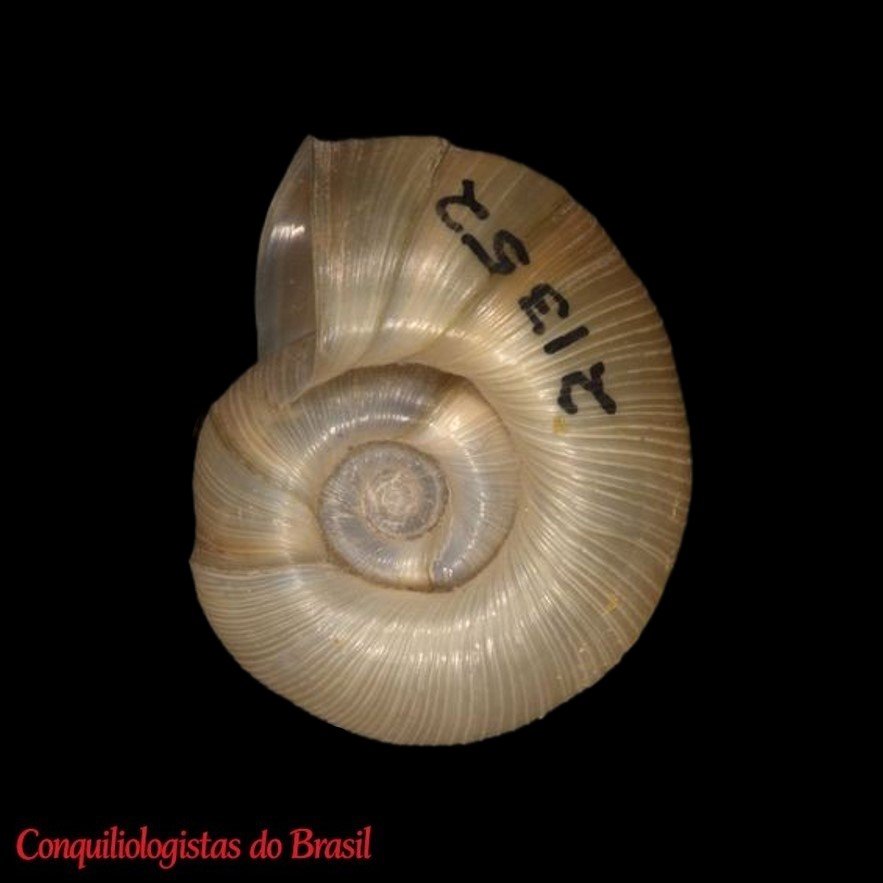
ESPÉCIE: Planorbella trivolvis (Say, 1817) – ESPÉCIE INVASORA
Tamanho: 13 – 20 mm
Ocorrência: EUA, Canadá, Brasil (Rio de Janeiro)
Localidade tipo: nd
Nome original: Planorbis trivolvis Say, 1817
Sinônimos: Bulla fluviatilis Say, 1821; Helisoma (Pierosoma) trivolvis (Say, 1817); Helisoma travertina B. A. Branson, 1961; Helisoma trivolvis (Say, 1817); Helisoma trivolvis marshalli F. C. Baker, 1945; Helisoma trivolvis var. chautauquensis F. C. Baker, 1928; Helisoma trivolvis var. holstonense F. C. Baker, 1945; Helisoma trivolvis var. marshalli F. C. Baker, 1945; Physa planorbula De Kay, 1843; Planorbella (Pierosoma) trivolvis (Say, 1817); Planorbis bellus I. Lea, 1841; Planorbis lentus Say, 1834; Planorbis macrostomus Whiteaves, 1863; Planorbis megastoma De Kay, 1843; Planorbis regularis I. Lea, 1841; Planorbis trivolvis Say, 1817; Planorbis trivolvis var. fallax Haldeman, 1842; Planorbis trivolvis var. winslowi F. C. Baker, 1926
Subespécies:
(i) Planorbella trivolvis intertextum (G. B. Sowerby II, 1877)
(ii) Planorbella trivolvis kolymensis (Lindholm, 1932) †
(iii) Planorbella trivolvis trivolvis (Say, 1817)
Fotos: (1,2) The Academy of Natural Sciences, Philadelphia: P. trivolvis (Say, 1817), ANSP 21352, EUA, Utha, Near Salt Lake, H. Hemphill Collection
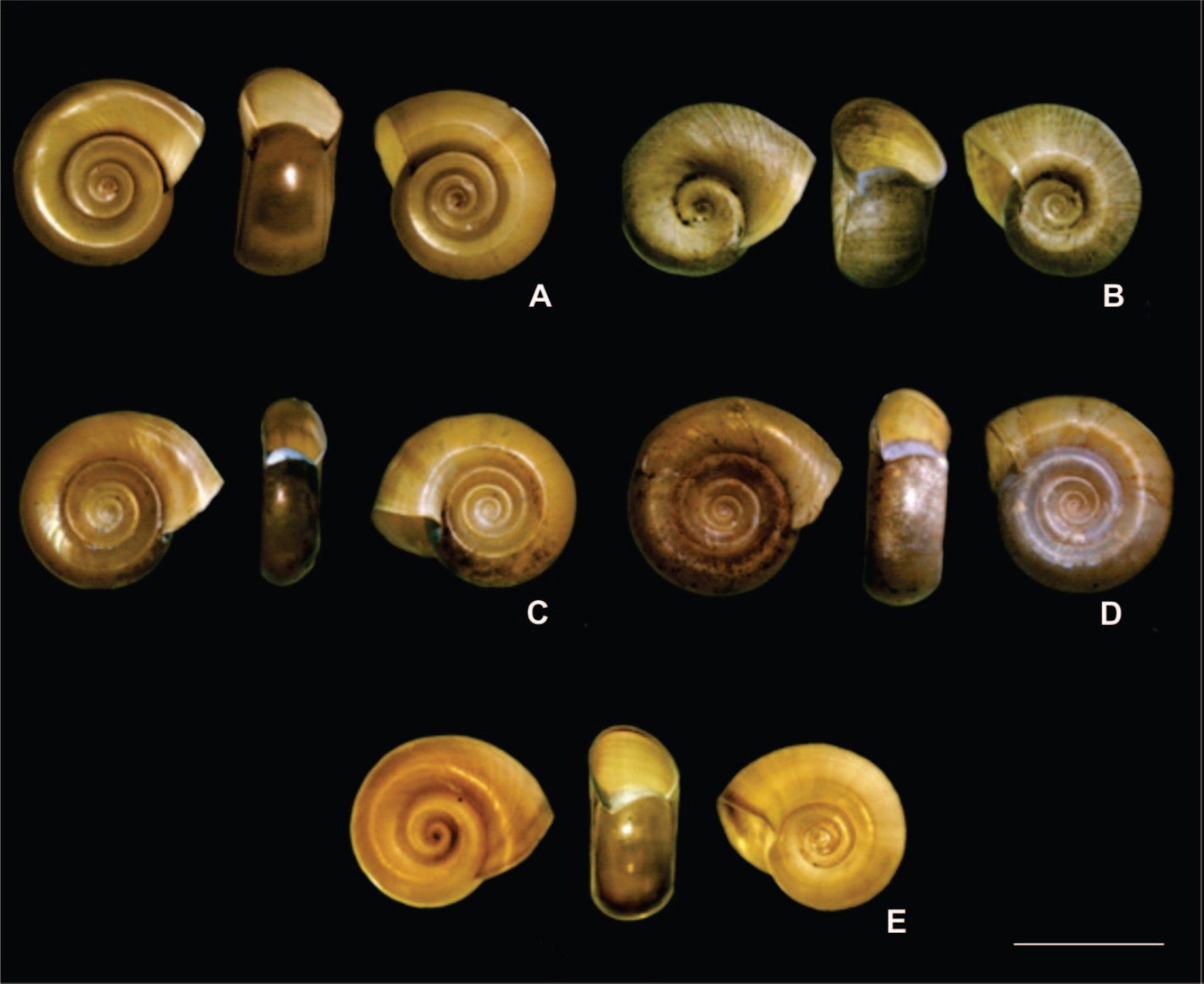
Figura: Fernadez et al. 2012: Conchas de espécies nativas e exóticas de Planorbidae. Para cada espécie é apresentada, respectivamente, o lado direito, a visão frontal e o lado esquerdo: (A) Planorbella duryi (Wetherby, 1879); (B) Planorbella trivolvis (Say, 1817); (C) Biomphalaria tenagophila (d’Orbigny, 1835); (D) Biomphalaria occidentalis Paraense, 1981; (E) Biomphalaria tenagophila guaibensis Paraense, 1984; Escala: 5 mm. (Fotos: P.M. Coelho)
Fontes:
Descrição original: (como Planorbis trivolvis Say, 1817) Say, T. (1817). Conchology. – In: Nicholson, W.: American edition of the British Encyclopedia, or, dictionary of arts and sciences comprising an accurate and popular view of the present improved state of human knowledge. First Edition, A-3 – C-6 [= 1-20], pl. [1-4].
página(s): [sem paginação], pl. 2, fig. 2
Descrição original: (como Helisoma travertina B. A. Branson, 1961) Branson, B.A. (1961). Recent Gastropoda of Oklahoma. Part II. Distribution, ecology and taxonomy of fresh-water species, with description of Helisoma travertina sp. nov. Oklahoma State University Publication, Arts and Sciences Studies, 58(17): 1-72.
página(s): 64, pl. 8, figs. 52-54
Descrição original: (como Physa planorbula De Kay, 1843) De Kay, J. E. (1843). Mollusca. Zoology of New-York, or the New-York fauna; comprising detailed descriptions of all the animals hitherto observed within the State of New-York; with brief notices of those occasionally found near its borders; and accompanied by appropriate illustrations. Carroll and Cook, Albany, New York. Part 5, pp. 1-271, plates 1-40., disponível online em http://biodiversitylibrary.org/page/2022507
página(s): 76, pl. 5, fig. 83
Descrição original: (como Planorbis megastoma De Kay, 1843) De Kay, J. E. (1843). Mollusca. Zoology of New-York, or the New-York fauna; comprising detailed descriptions of all the animals hitherto observed within the State of New-York; with brief notices of those occasionally found near its borders; and accompanied by appropriate illustrations. Carroll and Cook, Albany, New York. Part 5, pp. 1-271, plates 1-40., disponível online em http://biodiversitylibrary.org/page/2022507
página(s): 61, pl. 4, figs. 60-61
Descrição original: (como Planorbis regularis I. Lea, 1841) Lea, I. (1841). On fresh water and land shells (continuation) [fifty-seven new species]. Proceedings of the American Philosophical Society. 2(17): 30-34 [7 May 1841]., disponível online em http://biodiversitylibrary.org/page/34521454
página(s): 32
Descrição original: (como Planorbis bellus I. Lea, 1841) Lea, I. (1841). On fresh water and land shells (continuation) [fifty-seven new species]. Proceedings of the American Philosophical Society. 2(17): 30-34 [7 May 1841]., disponível online em http://biodiversitylibrary.org/page/34521454
página(s): 32
Descrição original: (como Bulla fluviatilis Say, 1821) Say, T. (1821). Description of univalve shells of the United States. Journal of the Academy of Natural Sciences of Philadelphia. 2(1): 149-179., disponível online em https://www.biodiversitylibrary.org/page/36831337
página(s): 178
Descrição original: (como Planorbis lentus Say, 1834) Say, T. (1830-1834). American Conchology, or descriptions of the shells of North America. Illustrated by coloured figures from original drawings executed from nature. School Press, New Harmony, Indiana. Part 1: plates 1-10 (1830); Part 2: plates 11-20 (April 1831); Part 3: plates 21-30 (September 1831a); Part 4: plates 31-40 (March 1832); Part 5: plates 41-50 (August 1832); Part 6: plates 51-60 (April 1834); Part 7: plates 61-68 and appendix [1 p.] (1834?, published after Say’s death; edited by T. A. Conrad)., disponível online em http://biodiversitylibrary.org/page/7959266
página(s): pt. 6: 6, pl. 4, fig. 1
Descrição original: (como Planorbis macrostomus Whiteaves, 1863) Whiteaves, J.F. (1863). On the land and fresh-water Mollusca of lower Canada. The Canadian Naturalist and Geologist, 8(2): 98-113.
página(s): 104, fig. 12
Fernandez, Monica & Santos, Sonia & Miyahira, Igor & Gonçalves, Isabela & Ximenes, Renata. (2012). Gastrópodes límnicos invasores: morfologia comparada. In book: Moluscos Límnicos Invasores no Brasil: biologia, prevenção, controle (pp.125-136) Chapter: Gastrópodes límnicos invasores: morfologia comparada. Publisher: Redes Editora
Paraense, W.L. 1976b. Helisoma trivolvis and some of its synonyms in the Neotropical región (Mollusca: Planorbidae). Revista Brasileira de Biologia 36: 187e204.
Santos, SB, Thiengo, SC, Fernandez, MA, Myahira, IC, Gonçalves, ICB, Ximenes, RF, Mansur, MCD, Pereira, D. pp 25-49. Especies de moluscos Limnicos Invasores no Brasil. In Moluscos limnicos nvasores no Brasil: Biologia, prevenção e controle. Mansur et al., Organizadores. Redes Editora, Porto Alegre, 2012
Molluscabase: https://molluscabase.org/aphia.php?p=taxdetails&id=593137

Vive em árvores e arbustos

Vive sob ou sobre pedras

Vive em corais ou recifes

Vive em algas marinhas

Vivem em fundos de cascalho de coral, pedra ou conchas

Vive no solo. Sob folhas ou enterada parte do tempo

Vive em fundos arenosos, enterrada ou sob ele.

Animais que nadam ou vivem livremente

Presos a certos animais ou parasitando

Vive em fundos lodosos

Vive em plantas de água doce

Seu habitat é desconhecido

Alimenta-se de plantas e algas

Alimenta-se de outros animais

Alimenta-se de qualquer fonte

Alimenta-se de animais mortos
Seu hábito alimentar é desconhecido


