
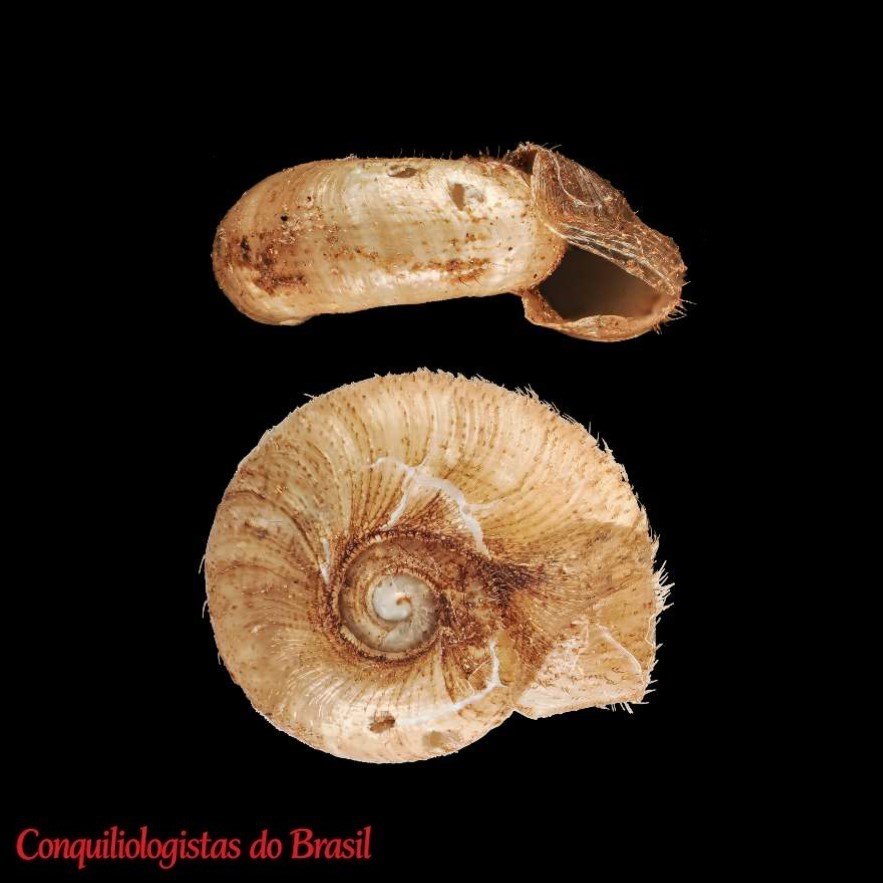
CLASSE: GASTROPODA: TERRESTRE
FAMÍLIA: SCOLODONTIDAE
ESPÉCIE: Hirtudiscus hirsutissimus Roosen et al. 2026
Tamanho médio: 5.6 mm
Distribuição: Panamá (Central Panama)
Localidade tipo: Fundación Geoversity, Centro Mamoní, Panama Province, Panama, 9°19’12” N, 79°08’42” W
Nome original: Hirtudiscus hirsutissimus Roosen et al. 2026
Etimologia: o epíteto específico ‘hirsutissimus’ significa ‘muito peludo’ ou ‘o peludo’ em Latim, referindo-se à grande quantidade de pelos periostracais longos que esta espécie possui
Zoobank: urn:lsid:zoobank.org:act:1D4C1121-E287-46AB-BFF0-C413786BB07E
Comentários: Roosen et al. 2026: “o holótipo (UF-594251) foi mantido vivo por um tempo por Dan Dourson. Durante esse período, o caracol deu à luz um filhote totalmente eclodido (UF-594252). Isso confirma as observações de Hausdorf (2003) de que pelo menos algumas espécies de Hirtudiscus são ovovivíparas.”
Descrição original:
(Roosen et al . 2026): “Shell of small size, nearly discoid in shape, with a brown, hairy periostracum and sunken spire. Protoconch 1 ½ whorl, with up to 11 apical spirals. Under high magnification, these spirals consist of a continuous series of spiral oriented ‘arches’. The protoconch – teleoconch transition is marked by ca. 9 axial ribs without other sculptural elements. On the teleoconch, the ribs at first become stronger and are extended into short lamellae with 6-7 short hairs on the upper surface.
On later teleoconch whorls, the axial ribs become less prominent and the periostracal hairs become larger on the 11 spiral oriented rows of hairs around the periphery of the shell. These hairs reach a length of up to 0.25 – 0.30 mm. The suture is distinct as younger whorls partially overlap preceding whorls and attach to them in an angle of nearly 90°. Aperture ovate, with a distinct incision in the parietal angle. Peristome simple, neither thickened nor reflected. Umbilicus open and very wide, up to 44% of the total width.”
Fotos: (1,2) Roosen et al 2026: Florida Museum of Natural History: HOLOTYPE UF 594251, 4.9 mm
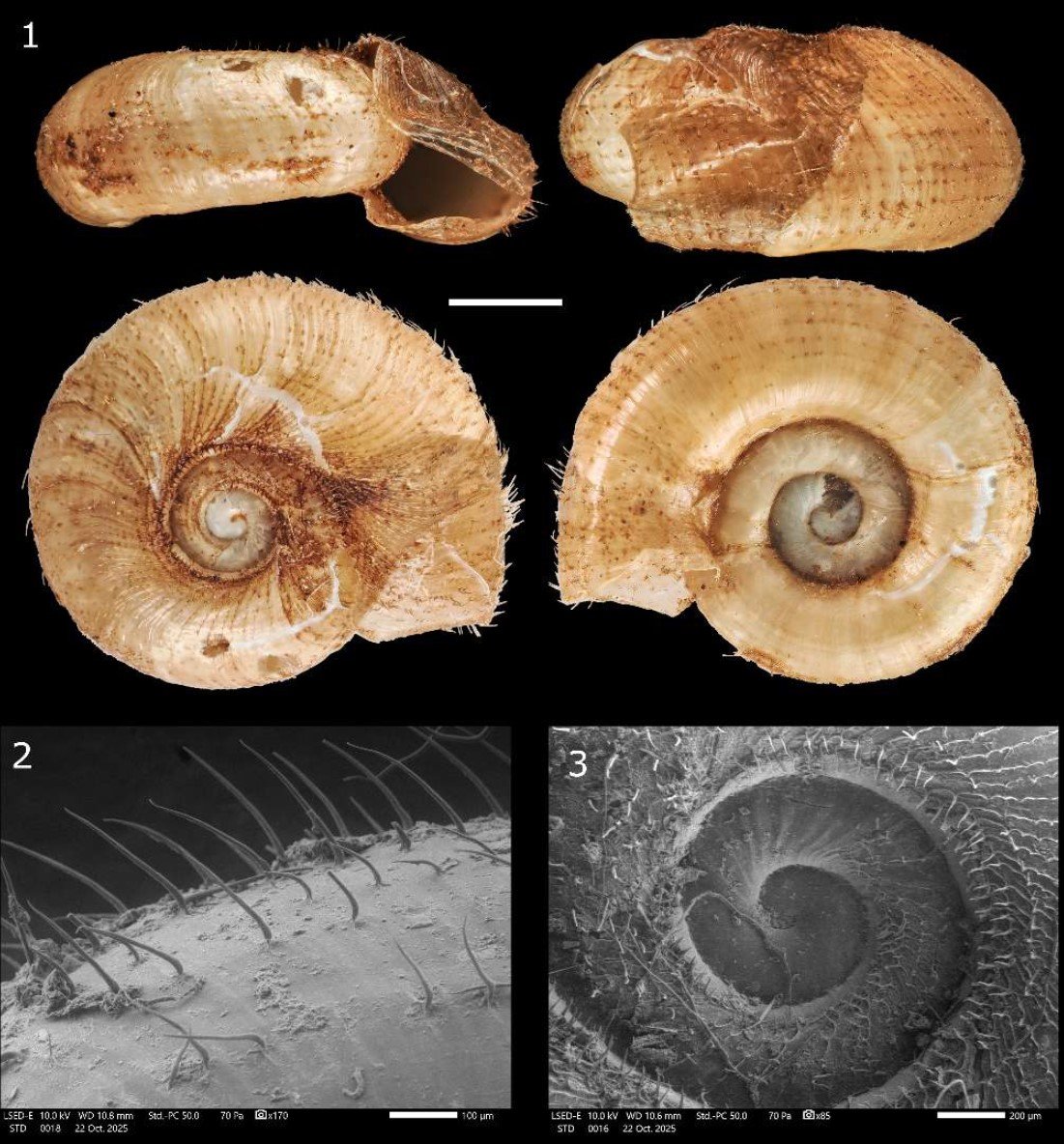
Figura: Roosen et al. 2026: Diferentes vistas e ampliações do holótipo (UF-594251): (1) vista da abertura, lateral, apical e umbilical, barra de escala 1 mm; (2) ampliação dos pelos periostracais na última verticilo, barra de escala 100 μm; (3) ampliação do ápice, mostrando a macroescultura dos verticilos iniciais, barra de escala 200 μm. Licença CC BY 4.0
Fontes:
Descrição original: Roosen MT, Baaijens E, Slats H, Dourson DC (2026) Description of a new species of Hirtudiscus Hylton Scott, 1973 (Gastropoda, Scolodontidae) from the Mamoní Valley Preserve (Central Panama). Molluscan Horizons 1: e260106, disponível online em https://molluscanhorizons.org/mh/article/view/6
Hausdorf B (2003) Systematic position and taxonomy of the genus Hirtudiscus from Colombia (Gastropoda: Scolodontidae). Journal of Molluscan Studies
69: 179-186
Molluscabase: nd

Vive em árvores e arbustos

Vive sob ou sobre pedras

Vive em corais ou recifes

Vive em algas marinhas

Vivem em fundos de cascalho de coral, pedra ou conchas

Vive no solo. Sob folhas ou enterada parte do tempo

Vive em fundos arenosos, enterrada ou sob ele.

Animais que nadam ou vivem livremente

Presos a certos animais ou parasitando

Vive em fundos lodosos

Vive em plantas de água doce

Seu habitat é desconhecido

Alimenta-se de plantas e algas

Alimenta-se de outros animais

Alimenta-se de qualquer fonte

Alimenta-se de animais mortos
Seu hábito alimentar é desconhecido


