

CLASSE: GASTROPODA: TERRESTRE
FAMÍLIA: ACHATINIDAE
ESPÉCIE: Rhodea wallisiana Dohrn, 1875
Tamanho médio: 34 – 37 mm
Ocorrência: Colômbia (Antioquia, Cundimarca, Magdalena)
Localidade tipo: Colômbia, “Neugranada”, “in parte superiore vallis Magdalenae“
Altitude: 1500 – 2600 m
Nome original: Rhodea wallisiana Dohrn, 1875
Etimologia: o nome da espécie é uma homenagem a Gustav Wallis (1830-1878), importante botânico alemão. Ele ficou famoso por introduzir mais de 1.000 novas espécies de plantas na Europa, tornando-se uma das figuras mais destacadas da “febre de orquídeas” da era vitoriana. Ele faleceu precocemente aos 48 anos em um hospital em Cuenca, no Equador, após contrair febre amarela, malária e disenteria durante suas expedições solitárias
Comentários: (1) De acordo com Pilsbry (1906: 235) o gênero Rhodea é vivíparo; (2) a maioria dos espécimes tipo foram provavelmente perdidos em Szczecin, juntamente com a Coleção Dohrn durante a Segunda Guerra Mundial, porém uma concha no Museum für Naturkunde Berlin (ZMB 25131, ex Dohrn collection) poderia ser um Síntipo
Descrição:
(Pilsbry, 1906: 236-237): “Shell sinistral, cylindric-turrite, thin, closely obliquely rugose-striate, chalky under a pale corneous deciduous cuticle without much gloss. Whorls 11 to 12, the upper a little convex, the middle ones flat, the last two concave in the middle, separated by an acute projecting carina; the base of the last whorl is excavated around the thread-like, nearly straight, much protracted and basally truncate columella; margin of the peristome arcuate; columella encircled with a wide lamina”
Fotos: (1) Grego J., Šteffek J. & Infante A.P. (2007): Natural History Museum, London, NHMUK 1875122, Rhodea wallisiana, “New Granada”, H=35.3 mm, foto Phil Crabb; (2) Museu Nacional de História Natural, Paris: MNHN 2000-4670, “New Granada”, ex. coll. Wallis
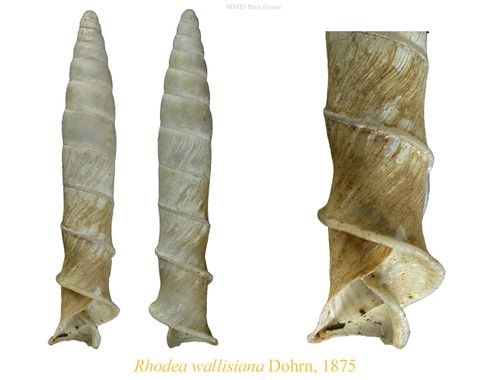
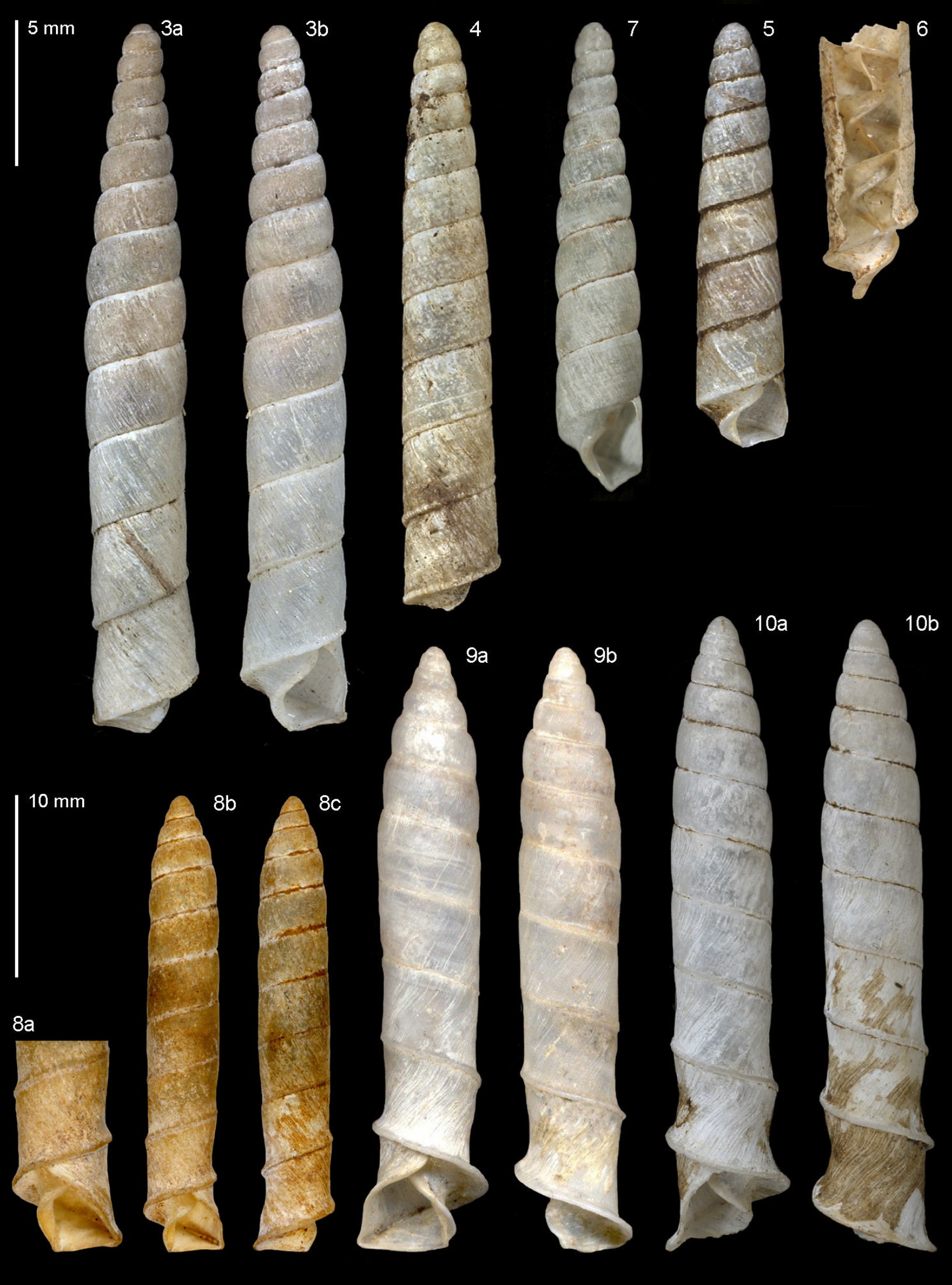
Figura: Grego J., Šteffek J. & Infante A.P. (2007):
(3-6) Rhodea californica (L. Pfeiffer, 1846); 3, “form A”, syntype 1, “Monterey, California”, H=24,0 mm, NHMUK 1985092, foto Phil Crabb; (4) “form B”, Colômbia, H=20,0 mm, coll. NHMUK acc. 2176, foto Phil Crabb; (5) “form B”, El Congo, Quilichao, Cauca, Colômbia, H=19,3 mm, 19,7 mm and 14,5 mm respectivamente, NHMUK 19086230, foto Phil Crabb; (6) Rhodea californica, Colômbia, coll ANSP 78438 section, fotoPaul Callomon;
(7) Rhodea gereti Jousseaume, 1900, HOLOTYPE, sem dados da localidade, H=16.1 mm, MHNH 4368, foto Delphine Brabant;
(8) Rhodea barcrofti Pilsbry, 1958, HOLOTYPE, “Monteredondo, km 73 from Bogotá to Villavicenzio”, H=24,9 mm, ANSP 211335, foto Paul Callomon;
(9-10) Rhodea wallisiana Dohrn, 1875; (9) “Mount of Amazon, Perdida, Santa Marta”, Colômbia, H=34 mm, coll. & photo Harry G. Lee; (10) “New Granada”, H=35,3 mm, NHMUK 1875122, foto Phil Crabb
Fontes:
Descrição original: Diagnosen neuer Landschnecken von Neugranda. Nachrichtsblatt der Deutschen Malakozoologischen Gesellschaft. 7: 56-58., disponível online em https://biodiversitylibrary.org/page/31031491
página(s): 57
Dohrn, H. (1875). Ueber einige von Herrn G. Wallis in Neugranada gesammelte Landconchylien. Jahrbücher der deutschen Malakozoologische Gesellschaft. 2: 292-309., disponível online em https://biodiversitylibrary.org/page/27002932
página(s): 307
Grego J., Šteffek J. & Infante A.P. (2007). Review of the genus Rhodea (Gastropoda, Pulmonata, Subulinidae) with description of two new species from Colombia. Basteria. 19, figs 9-10, 15
Linares, E. L., & Vera, M. L. (2012). Catálogo de los moluscos continentales de Colombia (Biblioteca José Jerónimo Triana No. 23). Bogotá, D.C., Colombia: Universidad Nacional de Colombia, Instituto de Ciencias Naturales
Pilsbry, H.A., 1906, 1907. Achatinidae: Stenogyrinae and Coeliaxinae (part.). — Manual of Conchology (second series: Pulmonata) 18: 161-272 (1906), 273-357 (1907). Philadelphia
MolluscaBase: https://molluscabase.org/aphia.php?p=taxdetails&id=1375515

Vive em árvores e arbustos

Vive sob ou sobre pedras

Vive em corais ou recifes

Vive em algas marinhas

Vivem em fundos de cascalho de coral, pedra ou conchas

Vive no solo. Sob folhas ou enterada parte do tempo

Vive em fundos arenosos, enterrada ou sob ele.

Animais que nadam ou vivem livremente

Presos a certos animais ou parasitando

Vive em fundos lodosos

Vive em plantas de água doce

Seu habitat é desconhecido

Alimenta-se de plantas e algas

Alimenta-se de outros animais

Alimenta-se de qualquer fonte

Alimenta-se de animais mortos
Seu hábito alimentar é desconhecido


